COURSE GROUP ON QUALITY

All courses in the QUALITY group can be applied to ALL INDUSTRIES.
Please contact John&Partners for detailed consultation.
LEAN SIX SIGMA YELLOW BELT
1. Overview
The course provides a foundation in Lean Six Sigma for beginners, helping them understand basic concepts of Lean and Six Sigma, ways to eliminate waste, reduce errors, and improve processes. Participants will learn how to apply simple tools such as 5 Whys, Pareto, and basic charts to support improvement projects within the business. This is an important starting step before advancing to Green Belt and Black Belt levels.
2. Suitable for Businesses
The course is suitable for businesses that:
. Want to equip employees with foundational knowledge of quality improvement.
. Are in the process of building or implementing a Lean Six Sigma program.
. Need a team to support improvement projects under the guidance of Green Belt/Black Belt.
. Aim to standardize improvement thinking across the organization.
3. Key Benefits
After completing the course, participants will be able to:
. Understand Lean Six Sigma principles and their connection to Operational Excellence.
. Identify waste, errors, and improvement opportunities in processes.
. Apply basic tools to analyze and improve work.
. Participate in Lean Six Sigma projects in a support role.
. Contribute to building a continuous improvement culture within the organization.
4. Duration & Outline
The duration and detailed content are flexibly designed based on the specific requirements of each business.
LEAN SIX SIGMA GREEN BELT
1. Overview
The course equips participants with Lean Six Sigma Green Belt knowledge and skills, focusing on leading medium-scale improvement projects using data analysis and process management tools to enhance productivity and quality. Participants will learn how to apply the DMAIC cycle (Define – Measure – Analyze – Improve – Control) along with basic statistical tools to minimize errors, eliminate waste, and improve operational efficiency.
2. Suitable for Businesses
The course is suitable for businesses that:
. Want to train key personnel capable of leading improvement projects.
. Are in the process of implementing a company-wide Lean Six Sigma program.
. Need mid-level improvement experts to collaborate with Black Belts on strategic projects.
. Aim to increase performance, improve quality, and reduce costs.
3. Key Benefits
After completing the course, participants will be able to:
. Understand and proficiently apply the DMAIC cycle in practice.
. Use basic data analysis and applied statistical tools.
. Lead medium-scale improvement projects with measurable results.
Support Black Belts in more complex projects.
. Act as improvement champions, spreading the Lean Six Sigma mindset within the organization.
4. Duration & Outline
The duration and detailed content are flexibly designed based on the specific requirements of each business.
LEAN SIX SIGMA BLACK BELT
1. Overview
The course for Lean Six Sigma Black Belt focuses on training leaders for large-scale improvement projects, with advanced data analysis, change management, and cross-functional team leadership capabilities. Participants will learn to apply the DMAIC cycle in depth, use advanced statistical tools, perform root cause analysis, and optimize processes, delivering strategic value and comprehensive impact for the organization.
2. Suitable for Businesses
The course is suitable for businesses that:
. Want to train senior improvement leaders capable of managing comprehensive projects.
. Are implementing a company-wide Lean Six Sigma program.
. Need personnel capable of leading cross-department, cross-functional improvement teams.
. Aim to significantly reduce costs, increase productivity, and sustainably improve quality.
3. Key Benefits
After completing the course, participants will be able to:
. Master advanced statistical tools and data analysis software.
. Design and implement large-scale, complex improvement projects.
. Lead cross-functional teams, manage change, and inspire improvement.
. Align improvement initiatives with the organization’s strategic goals.
. Become a comprehensive improvement leader, delivering measurable value.
4. Duration & Outline
The duration and detailed content are flexibly designed based on the specific requirements of each business.
LEAN SIX SIGMA MASTER BLACK BELT
1. Overview
The Lean Six Sigma Master Black Belt (MBB) course is designed for senior professionals who have experience leading multiple improvement projects. The program focuses on strategic mentoring, coaching Green Belts & Black Belts, and building a comprehensive improvement system aligned with business strategy. Participants will learn how to manage project portfolios, design quality strategies, and coordinate Lean Six Sigma programs at the organizational level.
2. Suitable for Enterprises
The course is suitable for enterprises that:
. Want to develop an internal advisory team to maintain and expand the Lean Six Sigma program.
. Are implementing OPEX/Lean Six Sigma programs at the corporate-wide level.
. Need experts capable of coaching, mentoring, and developing competencies for other Belts.
. Aim to build a sustainable improvement system aligned with business strategy.
3. Value Delivered
After completing the course, participants will be able to:
. Master the capability to mentor and coach Green Belts and Black Belts.
. Design and manage organizational-level improvement programs.
. Manage Lean Six Sigma project portfolios aligned with business strategy.
. Serve as a strategic advisor, supporting senior leadership in improvement and quality.
. Build a sustainable improvement culture across the entire organization.
4. Duration & Outline
The duration and detailed content are flexibly designed based on the specific requirements of each enterprise.
STATISTICAL PROCESS CONTROL (SPC) & CONTROL CHARTS
1. Overview
The course provides knowledge and skills in Statistical Process Control (SPC) and Control Charts, helping enterprises monitor, analyze, and control processes using statistical data. Participants will learn how to identify process variation, distinguish between common causes and special causes, and apply control charts to maintain stability and drive continuous improvement in operations. This is one of the foundational tools of Lean Six Sigma and TQM.
2. Suitable for Enterprises
The course is suitable for enterprises that:
. Want to standardize and monitor processes based on data rather than intuition.
. Are facing challenges in maintaining stable quality and reducing variation.
. Need to enhance the capabilities of technical, quality, and production teams.
. Aim to meet international standards in quality management.
3. Value Delivered
After completing the course, participants will be able to:
. Understand the principles of SPC and the role of Control Charts in quality management.
. Identify and analyze process variation data.
. Select and use different types of control charts (X-bar, R, p, np, c, u charts, etc.).
. Apply SPC to prevent defects, reduce errors, and improve processes.
. Create a foundation for data-driven quality management across the organization.
4. Duration & Outline
The duration and detailed content are flexibly designed based on the specific requirements of each enterprise.
MEASUREMENT SYSTEM ANALYSIS (MSA)
1. Overview
The course focuses on Measurement System Analysis (MSA) – a method for assessing the reliability and accuracy of measurement systems within an enterprise. Participants will learn how to check measurement errors (bias, repeatability, reproducibility, stability, linearity), determine the suitability of measurement tools, and ensure that the data used for process improvement and decision-making is accurate. This is a mandatory step in Lean Six Sigma and modern quality management.
2. Suitable for Enterprises
The course is suitable for enterprises that:
. Heavily rely on measurement data to control quality.
. Want to ensure measurement results reflect reality accurately without bias.
. Need technical, QA/QC, and production teams equipped with measurement system analysis capabilities.
. Aim to improve data reliability for process improvement and to achieve ISO/Lean Six Sigma certification.
3. Value Delivered
After completing the course, participants will be able to:
. Understand the concept and role of MSA in quality management.
. Analyze and evaluate repeatability and reproducibility.
. Perform Gauge R&R studies to validate measurement systems.
. Enhance the accuracy and reliability of measurement data.
. Ensure quality data used for improvement, reporting, and decision-making is valid.
4. Duration & Outline
The duration and detailed content are flexibly designed based on the specific requirements of each enterprise.
FAILURE MODE & EFFECTS ANALYSIS (FMEA)
1. Overview
The course focuses on Failure Mode & Effects Analysis (FMEA) – a systematic method to identify, evaluate, and prevent potential risks in processes, products, or services. Participants will learn how to classify failures according to Severity, Occurrence, and Detection to calculate the Risk Priority Number (RPN). This is an essential tool that helps enterprises minimize risks, prevent errors from the start, and enhance the reliability of products/services.
2. Suitable for Enterprises
The course is suitable for enterprises that:
. Are developing new products, services, or process improvements.
. Want to prevent risks and errors before they affect customers.
. Need QA/QC, production, and R&D teams proficient in systematic risk assessment methods.
. Aim to improve quality, safety, and customer satisfaction.
3. Value Delivered
After completing the course, participants will be able to:
. Understand the principles and benefits of FMEA in quality management.
. Identify and evaluate risks in processes, products, or services.
. Develop FMEA tables with S – O – D indicators and RPN.
. Propose risk mitigation solutions to enhance reliability.
. Integrate FMEA into Lean Six Sigma, ISO projects, and continuous improvement initiatives.
4. Duration & Outline
The duration and detailed content are flexibly designed based on the specific requirements of each enterprise.
DESIGN OF EXPERIMENTS (DOE)
1. Overview
The course focuses on Design of Experiments (DOE) – a scientific method for designing and analyzing experiments to identify critical factors affecting process quality and performance. Participants will learn how to plan, conduct, and analyze controlled experiments, using statistical tools to determine cause-and-effect relationships and optimize processes. This is one of the advanced skills in Lean Six Sigma Black Belt and modern quality management.
2. Suitable for Enterprises
The course is suitable for enterprises that:
. Need to optimize production or service processes.
. Want to identify and control critical factors affecting quality.
. Need to enhance the capabilities of R&D, QA/QC, and production teams in data analysis.
. Aim to reduce experimental costs, shorten improvement cycles, and increase stable quality.
3. Value Delivered
After completing the course, participants will be able to:
. Understand the principles and benefits of DOE in quality improvement.
. Design experiments suitable for the research objectives.
. Analyze experimental data using applied statistical tools.
. Identify key factors and important interactions in processes.
. Apply DOE to optimize processes, products, and services.
4. Duration & Outline
The duration and detailed content are flexibly designed based on the specific requirements of each enterprise.
FUNCTION DEPLOYMENT (QFD) HOUSE OF QUALITY
1. Overview
The course focuses on Quality Function Deployment (QFD), especially the House of Quality tool, helping enterprises translate the Voice of Customer (VOC) into technical requirements and operational standards. Participants will learn how to identify customer needs, prioritize critical requirements, and translate them into specific design, process, or product solutions. This is a strategic tool in quality management, R&D, and product/service design.
2. Suitable for Enterprises
The course is suitable for enterprises that:
. Want to closely align customer needs with design and production activities.
. Are developing new products/services or improving existing products.
. Need R&D, QA/QC, marketing, and production teams to collaborate effectively.
. Aim to increase customer satisfaction and gain a competitive advantage.
3. Value Delivered
After completing the course, participants will be able to:
. Understand the principles and process of QFD.
. Build the House of Quality to translate VOC into specifications.
. Prioritize Critical to Quality (CTQ) factors.
. Enhance cross-functional collaboration in product/service development.
. Ensure products/services meet customer expectations from the outset.
4. Duration & Outline
The duration and detailed content are flexibly designed based on the specific requirements of each enterprise.
VOICE OF THE CUSTOMER (VOC) & CRITICAL TO QUALITY (CTQ)
1. Overview
The course focuses on Voice of the Customer (VOC) and Critical to Quality (CTQ) – two foundational tools in modern quality management. Participants will learn how to collect and analyze customer feedback, and then translate it into technical requirements and measurable indicators. From this, enterprises can identify CTQ factors, ensuring products/services meet customer expectations and comply with international quality standards.
2. Suitable for Enterprises
The course is suitable for enterprises that:
. Want to put the customer at the center of product and service design.
. Are seeking to link VOC with quality improvement processes.
. Need R&D, QA/QC, marketing, and production teams to collaborate closely to enhance customer experience.
. Aim to create value beyond expectations and increase customer satisfaction.
3. Value Delivered
After completing the course, participants will be able to:
. Understand the concepts and roles of VOC & CTQ in quality management.
. Collect and analyze customer data (surveys, interviews, behavioral data).
. Identify CTQ factors for measurement and quality control.
. Link VOC to QFD, Six Sigma, and improvement programs.
. Enhance customer experience (CX) and build sustainable competitive advantage.
4. Duration & Outline
The duration and detailed content are flexibly designed based on the specific requirements of each enterprise.
ADVANCED PRODUCT QUALITY PLANNING
1. Overview
The course focuses on Advanced Product Quality Planning (APQP) – an advanced quality management method that helps plan, implement, and monitor product quality from the design and development stage. Participants will learn how to synchronize customer requirements with design, R&D, production, and control activities, ensuring the final product meets quality, cost, and timeline requirements. This is an essential tool in industries such as automotive, aerospace, electronics, and mass production.
2. Suitable for Enterprises
The course is suitable for enterprises that:
. Operate in industrial manufacturing and global supply chains.
. Want to ensure quality from the product design and development stage.
. Need QA/QC, R&D, production, and project management teams to collaborate closely.
. Aim to reduce risks, save costs, and accelerate product launch.
3. Value Delivered
After completing the course, participants will be able to:
. Understand the 5-phase structure of APQP: Planning, Product Design &. Development, Process Design & Development, Production Validation, and Feedback & Continuous Improvement.
. Link VOC and CTQ with technical requirements and quality standards.
. Apply APQP to reduce defects, lower production costs, and continuously improve products.
. Coordinate effectively among R&D – production – QA/QC – suppliers.
. Build competitive capabilities based on superior quality and reliability.
4. Duration & Outline
The duration and detailed content are flexibly designed based on the specific requirements of each enterprise.
TOTAL QUALITY MANAGEMENT (TQM)
1. Overview
The course focuses on Total Quality Management (TQM) – a management approach that helps build a comprehensive quality culture within an enterprise. Participants will learn how to put the customer at the center, standardize processes, and encourage participation from all employees in continuous improvement activities. TQM is not only a system of tools but also a strategic mindset for enterprises to achieve superior quality, minimize errors, and enhance customer satisfaction.
2. Suitable for Enterprises
The course is suitable for enterprises that:
. Want to build a sustainable quality management system rather than isolated improvement activities.
. Are aiming for ISO, Lean Six Sigma, or other international standards certifications.
. Need to strengthen quality culture, embedding quality into daily operations.
. Aim to increase customer satisfaction and long-term competitive advantage.
3. Value Delivered
After completing the course, participants will be able to:
. Understand the core principles of TQM and how to apply them in practice.
. Build a comprehensive quality management system linking strategy with operations.
. Establish a culture of continuous improvement with full employee engagement.
. Integrate TQM with Lean, Six Sigma, and other quality management tools.
. Enhance customer satisfaction and long-term operational effectiveness.
4. Duration & Outline
The duration and detailed content are flexibly designed based on the specific requirements of each enterprise.
ISO 9001:2015 IMPLEMENTATION TRAINING
1. Overview
The course focuses on ISO 9001:2015, the most widely recognized international standard for Quality Management Systems (QMS). Participants will learn how to understand and implement the standard’s requirements, from risk management, quality planning, document control to internal audits and continuous improvement. The program emphasizes risk-based thinking and how to align ISO 9001 with business strategy and operations.
2. Suitable for Enterprises
The course is suitable for enterprises that:
. Want to establish or upgrade a quality management system according to ISO 9001:2015.
. Are preparing for ISO certification or recertification.
. Need to enhance the capabilities of QA/QC, process management, and operational management teams.
. Aim to increase customer satisfaction, reduce risks, and enhance international credibility.
3. Value Delivered
After completing the course, participants will be able to:
. Understand the structure and core requirements of ISO 9001:2015.
. Build, implement, and maintain an effective QMS.
. Conduct internal audits and prepare for certification.
. Integrate ISO 9001 with Lean Six Sigma, TQM, and other improvement tools.
. Establish a solid quality foundation that meets global standards.
4. Duration & Outline
The duration and detailed content are flexibly designed based on the specific requirements of each enterprise.
ISO 14001 & ISO 45001
1. Overview
The course focuses on ISO 14001 (Environmental Management) and ISO 45001 (Occupational Health & Safety Management) – two important international standards that help enterprises protect the environment, ensure workplace safety, and promote sustainable development. Participants will learn how to establish, implement, and maintain environmental and safety management systems, comply with international legal requirements, and align them with ESG strategies and sustainability goals.
2. Suitable for Enterprises
The course is suitable for enterprises that:
. Want to achieve ISO 14001 and/or ISO 45001 certification to enhance credibility.
. Are aiming to minimize environmental risks, workplace accidents, and operational incidents.
. Need EHS (Environment, Health & Safety), QA/QC, and production teams to master international standards.
. Aim to promote sustainable development, enhance safety, and strengthen social responsibility.
3. Value Delivered
After completing the course, participants will be able to:
. Understand the structure and requirements of ISO 14001 & ISO 45001.
. Build and integrate environmental and safety management systems into operations.
. Ensure compliance with legal regulations and international standards.
. Reduce environmental risks, accidents, and costs arising from incidents.
. Align management systems with sustainability and ESG strategies.
4. Duration & Outline
The duration and detailed content are flexibly designed based on the specific requirements of each enterprise.
CROOT CAUSE ANALYSIS
(ADVANCED QUALITY TOOLS)
1. Overview
The course focuses on Advanced Root Cause Analysis (RCA), helping enterprises identify, analyze, and eliminate the root causes of quality issues rather than just addressing symptoms. Participants will be equipped with advanced tools such as Advanced Fishbone Diagram, Multi-level Pareto Analysis, Advanced 5 Whys, Fault Tree Analysis (FTA), and Failure Mode Mapping, to enhance accuracy and effectiveness in quality improvement.
2. Suitable for Enterprises
The course is suitable for enterprises that:
. Are facing complex, recurring quality issues.
. Want to develop deep analytical capabilities for QA/QC, production, and engineering teams.
. Need to integrate RCA with Lean Six Sigma and ISO tools.
. Aim to eliminate errors thoroughly and enhance product and service reliability.
3. Value Delivered
After completing the course, participants will be able to:
. Understand the principles and process of advanced RCA.
. Proficiently use modern root cause analysis tools.
. Integrate RCA into DMAIC and the quality management system.
. Reduce recurring issues that cause costly failures.
. Enhance investigation, problem-solving, and sustainable improvement capabilities.
4. Duration & Outline
The duration and detailed content are flexibly designed based on the specific requirements of each enterprise.
DESIGN FOR SIX SIGMA (DFSS)
1. Overview
The course focuses on Design for Six Sigma (DFSS) – a product/service development method based on customer needs and quantitative data, ensuring quality is integrated from the design stage. Participants will learn how to apply the DMADV model (Define – Measure – Analyze – Design – Verify) and use statistical tools, VOC, CTQ, and QFD to design products/services that exceed customer expectations and reduce the risk of defects during operation.
2. Suitable for Enterprises
The course is suitable for enterprises that:
. Are developing new products or services.
. Want to ensure quality and reliability are designed from the start rather than controlled only at the end of the process.
. Need R&D, QA/QC, production engineers, and product management teams to master the DFSS methodology.
. Aim to shorten time-to-market, reduce testing costs, and increase customer satisfaction.
3. Value Delivered
After completing the course, participants will be able to:
. Understand the concept, process, and benefits of DFSS.
. Apply DMADV to design optimal products/services.
. Integrate VOC, CTQ, and QFD into the design process.
. Minimize defect risks and post-launch improvement costs.
. Build long-term competitive capabilities through superior quality design.
4. Duration & Outline
The duration and detailed content are flexibly designed based on the specific requirements of each enterprise.
SUPPLIER QUALITY MANAGEMENT
1. Overview
The course focuses on Supplier Quality Management (SQM) – a management system that helps enterprises ensure input quality from suppliers, minimize supply chain risks, and build sustainable partnerships. Participants will learn how to evaluate, select, monitor, and develop suppliers through quality standards, performance indicators (KPIs), and continuous improvement mechanisms. This is a key factor for optimizing costs, enhancing product quality, and maintaining brand reputation.
2. Suitable for Enterprises
The course is suitable for enterprises that:
. Are heavily dependent on global supply chains and suppliers.
. Want to minimize quality risks from raw materials, components, or input services.
. Need purchasing, QA/QC, and supply chain management teams to have skills in supplier quality control.
. Aim to increase stability, reduce costs, and build strategic partnerships.
3. Value Delivered
After completing the course, participants will be able to:
. Understand the role and process of Supplier Quality Management.
. Develop criteria to evaluate and select suppliers.
. Apply KPIs and SLAs (Service Level Agreements) to manage supplier performance.
. Develop strategic, win-win partnerships with suppliers.
. Ensure stable input quality, contributing to enhanced output quality.
4. Duration & Outline
The duration and detailed content are flexibly designed based on the specific requirements of each enterprise.
COST OF POOR QUALITY (COPQ) ANALYSIS
1. Overview
The course focuses on Cost of Poor Quality (CoPQ) – a method to measure and analyze costs arising from defects, scrap, rework, delayed deliveries, or failure to meet customer requirements. Participants will learn how to categorize quality costs (prevention, appraisal, internal failure, external failure) to determine the financial impact of poor quality on business profitability. This is a key tool for developing cost-reduction strategies and enhancing operational efficiency.
2. Suitable for Enterprises
The course is suitable for enterprises that:
. Want to quantify poor quality costs to identify waste and losses.
. Are experiencing high rates of scrap, rework, or customer complaints.
Need finance, QA/QC, production, and operations management teams to collaborate in cost optimization.
. Aim to increase profitability by controlling quality and reducing waste.
3. Value Delivered
After completing the course, participants will be able to:
. Understand the structure and classification of quality costs.
. Measure and analyze CoPQ using real data.
. Determine the financial impact of defects and quality waste.
. Develop strategies to reduce poor quality costs.
. Link CoPQ with Lean, Six Sigma, and corporate cost management.
4. Duration & Outline
The duration and detailed content are flexibly designed based on the specific requirements of each enterprise.
RELIABILITY ENGINEERING &
QUALITY ASSURANCE
1. Overview
The course focuses on Reliability Engineering and Quality Assurance (QA) – two key pillars that help enterprises ensure products/services operate reliably, safely, and durably over time. Participants will learn how to perform reliability analysis, forecast product lifespan, manage failure risks, and build QA systems to monitor, inspect, and continuously improve. This forms the foundation for increasing reliability, reducing warranty costs, and enhancing customer satisfaction.
2. Suitable for Enterprises
The course is suitable for enterprises that:
. Operate in manufacturing, engineering, technology, or service sectors with high reliability requirements.
. Want to minimize failures, malfunctions, and warranty costs.
. Need R&D, QA/QC, production, and maintenance teams equipped with analytical and quality assurance skills.
. Aim to increase product reliability, brand reputation, and customer trust.
3. Value Delivered
After completing the course, participants will be able to:
. Understand the principles of Reliability Engineering and QA.
. Perform reliability analyses (Weibull, MTBF, RCM).
. Build and operate modern QA systems.
. Integrate QA with SPC, FMEA, DFSS, and other Lean Six Sigma tools.
. Enhance sustainable quality and customer satisfaction.
4. Duration & Outline
The duration and detailed content are flexibly designed based on the specific requirements of each enterprise.
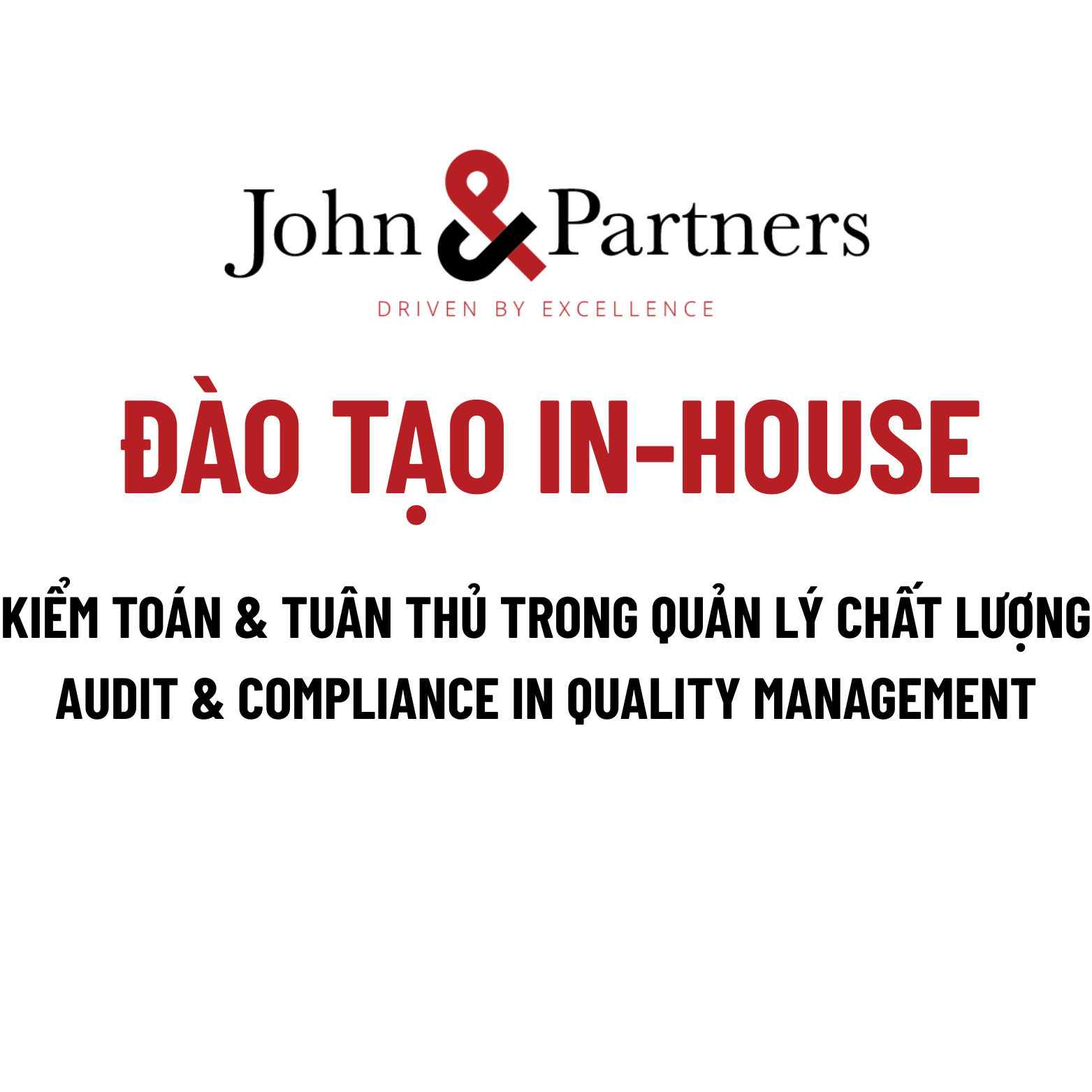
AUDIT & COMPLIANCE IN
QUALITY MANAGEMENT
1. Overview
The course focuses on Audit & Compliance in quality management, helping enterprises establish, execute, and maintain internal audit systems to ensure ISO standards, legal regulations, and customer requirements are met. Participants will learn how to plan, conduct, and report audits, while developing the ability to identify nonconformities, propose corrective actions, and improve the quality system. This is a critical skill for maintaining ISO certification and enhancing international credibility.
2. Suitable for Enterprises
The course is suitable for enterprises that:
. Are implementing or preparing for ISO 9001, ISO 14001, ISO 45001, or other international standards.
. Want to strengthen internal audit capabilities and compliance monitoring.
. Need QA/QC, process management, risk management, and operations teams capable of auditing the quality system.
. Aim to reduce risks, prevent errors, and maintain customer trust.
3. Value Delivered
After completing the course, participants will be able to:
. Understand the principles of auditing and compliance in quality management.
. Conduct internal audits proficiently (planning – execution – reporting – follow-up).
. Identify nonconformities and propose corrective actions.
. Link quality audits with risk management and continuous improvement.
. Ensure the enterprise maintains compliance, achieves certification, and enhances credibility.
4. Duration & Outline
The duration and detailed content are flexibly designed based on the specific requirements of each enterprise.
Register For In-House Training
Copyright 2025 © John&Partners Consulting and Education Joint Stock Company