


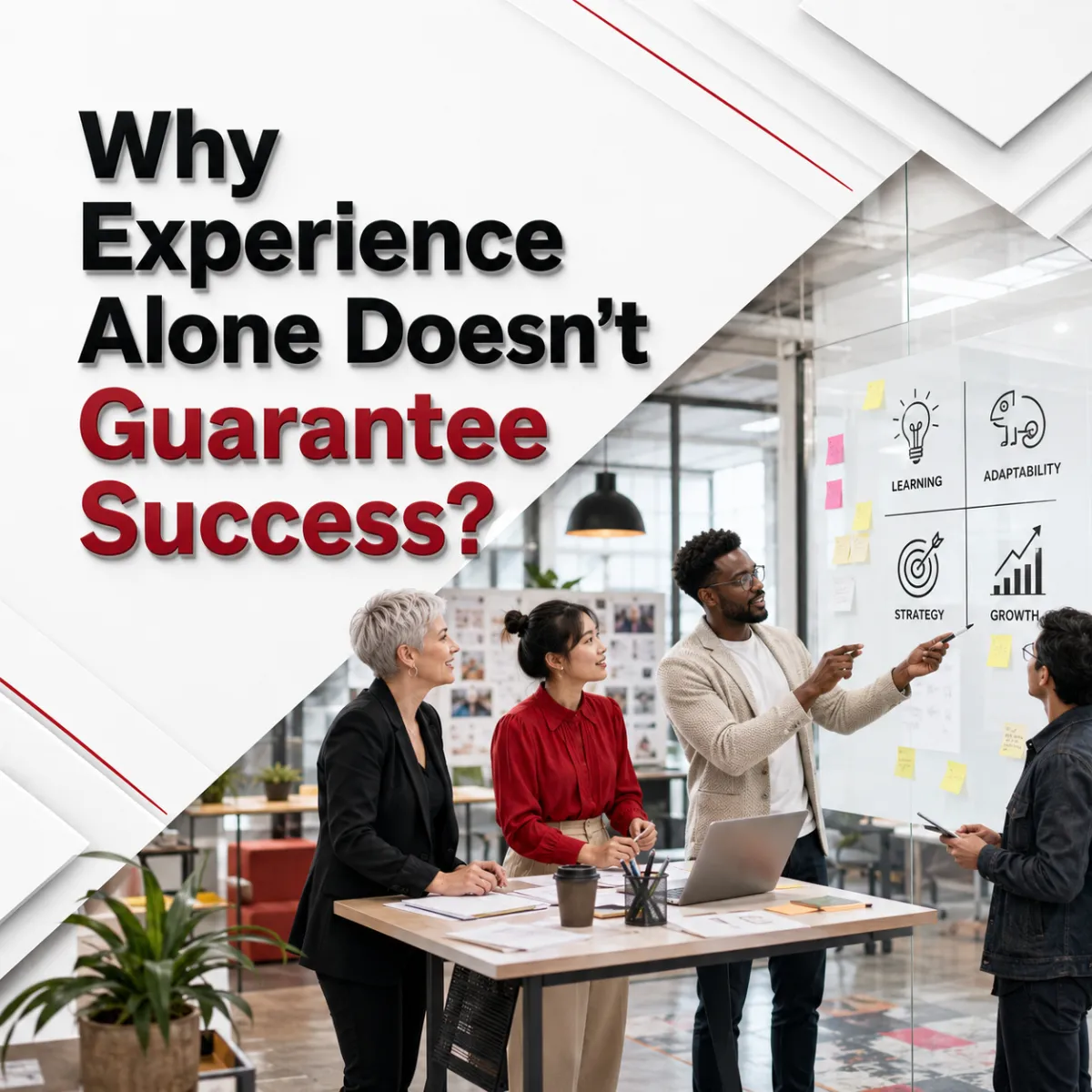
Why Experience Alone Doesn't Guarantee Success
For many years, experience has been considered one of the most valuable assets in business and leadership.
Job descriptions ask for it. Organizations reward it. Professionals often take pride in it.
And rightly so.
Experience provides knowledge, insight, and perspective that can only be gained through real-world challenges.
However, in today's rapidly changing environment, experience alone is no longer enough to guarantee success.
Many highly experienced professionals struggle to adapt, while others with less experience continue to grow, innovate, and create exceptional results.
Why does this happen?
Because success is not determined solely by how long someone has worked.
It is determined by how effectively they learn, adapt, and evolve.
At John&Partners, we believe experience provides a foundation, but continuous growth creates lasting success.
Experience Is Valuable, But It Has Limits
Experience teaches important lessons.
It helps people:
Recognize patterns
Avoid common mistakes
Make faster decisions
Build confidence
Develop expertise
These advantages are significant.
However, experience can also create assumptions.
People may begin to rely heavily on what worked in the past without recognizing that circumstances have changed.
Markets evolve.
Technology advances.
Customer expectations shift.
Business models transform.
What created success yesterday may not create success tomorrow.
Experience becomes most valuable when combined with adaptability.
The World Changes Faster Than Ever
The modern business environment moves at an unprecedented pace.
Artificial intelligence is transforming industries.
Digital platforms continue to reshape customer behavior.
Global competition increases every year.
Organizations face constant disruption.
In this environment, relying exclusively on past experience can become risky.
Leaders who only depend on what they already know may struggle to recognize new opportunities or emerging threats.
The most successful professionals combine experience with curiosity and continuous learning.
They understand that learning never stops.
Experience Without Reflection Creates Repetition
One common misconception is that years of experience automatically lead to wisdom.
In reality, experience alone does not guarantee growth.
A person can repeat the same habits, decisions, and mistakes for many years.
Growth occurs when experience is combined with reflection.
High-performing professionals regularly ask:
What worked?
What didn't work?
What can I improve?
What assumptions should I challenge?
What have I learned?
Reflection transforms experience into insight.
Without reflection, experience often becomes repetition.
Adaptability Is the New Competitive Advantage
Many organizations once competed primarily through scale, resources, or industry expertise.
Today, adaptability has become one of the most important competitive advantages.
Adaptable professionals:
Learn new skills quickly
Embrace change
Explore new perspectives
Adjust strategies when necessary
Remain open to innovation
Experience provides context.
Adaptability provides relevance.
The combination of both creates long-term value.
Continuous Learning Separates Top Performers
One characteristic consistently found among high-performing leaders is a commitment to learning.
Despite years of experience, successful leaders continue to:
Read extensively
Seek coaching
Attend development programs
Learn from mentors
Explore emerging trends
Challenge their own thinking
They understand that expertise is not a destination.
It is an ongoing process.
The moment people believe they know everything is often the moment growth begins to slow.
Expertise Can Sometimes Create Blind Spots
Experience often creates confidence.
Confidence is valuable.
However, excessive confidence can create blind spots.
Professionals with deep expertise sometimes become:
Resistant to new ideas
Overly reliant on previous successes
Less willing to seek feedback
Less open to experimentation
This phenomenon is not uncommon.
Organizations often encounter experienced leaders who unintentionally limit innovation because they believe existing approaches are sufficient.
Great leaders remain humble enough to learn.
They recognize that expertise should expand possibilities, not restrict them.
Success Requires More Than Technical Knowledge
Technical expertise can help someone become successful initially.
However, long-term success often depends on broader capabilities.
These include:
Leadership
Communication
Strategic thinking
Emotional intelligence
Decision-making
Coaching and mentoring
Collaboration
Many professionals advance in their careers because of technical expertise.
They sustain success because of leadership capability.
Experience may open doors.
Leadership helps keep them open.
Why Coaching Accelerates Growth
One reason coaching has become increasingly important is because it helps experienced professionals continue growing.
Coaching encourages:
Self-awareness
Reflection
Accountability
Better decision-making
Strategic thinking
Coaching challenges assumptions and helps leaders identify opportunities for improvement.
Even highly experienced executives often benefit from external perspectives.
Growth accelerates when learning becomes intentional.
The Difference Between Experience and Capability
Experience measures how long someone has been exposed to situations.
Capability measures how effectively someone can perform.
The two are related, but they are not identical.
A professional with ten years of experience may not necessarily outperform someone with five years of experience if the latter has:
Learned more effectively
Adapted more quickly
Developed stronger leadership skills
Improved continuously
Organizations increasingly value capability over tenure.
Results matter more than time served.
Building Future Success
To remain successful in a changing world, professionals should focus on:
Lifelong learning
Adaptability
Continuous improvement
Strategic thinking
Leadership development
Seeking feedback
Embracing innovation
These behaviors help transform experience into sustainable competitive advantage.
The goal is not simply to accumulate years.
The goal is to maximize growth during those years.
Final Takeaway
Experience remains one of the most valuable assets in business.
But experience alone does not guarantee success.
Success comes from combining experience with curiosity, learning, adaptability, reflection, and continuous development.
At John&Partners, we believe the most successful leaders are not those who rely solely on what they already know.
They are the ones who continue learning, evolving, and preparing for what comes next.
Because experience tells you where you have been.
Growth determines where you can go.
And in today's world, the ability to learn may be the most valuable experience of all.