


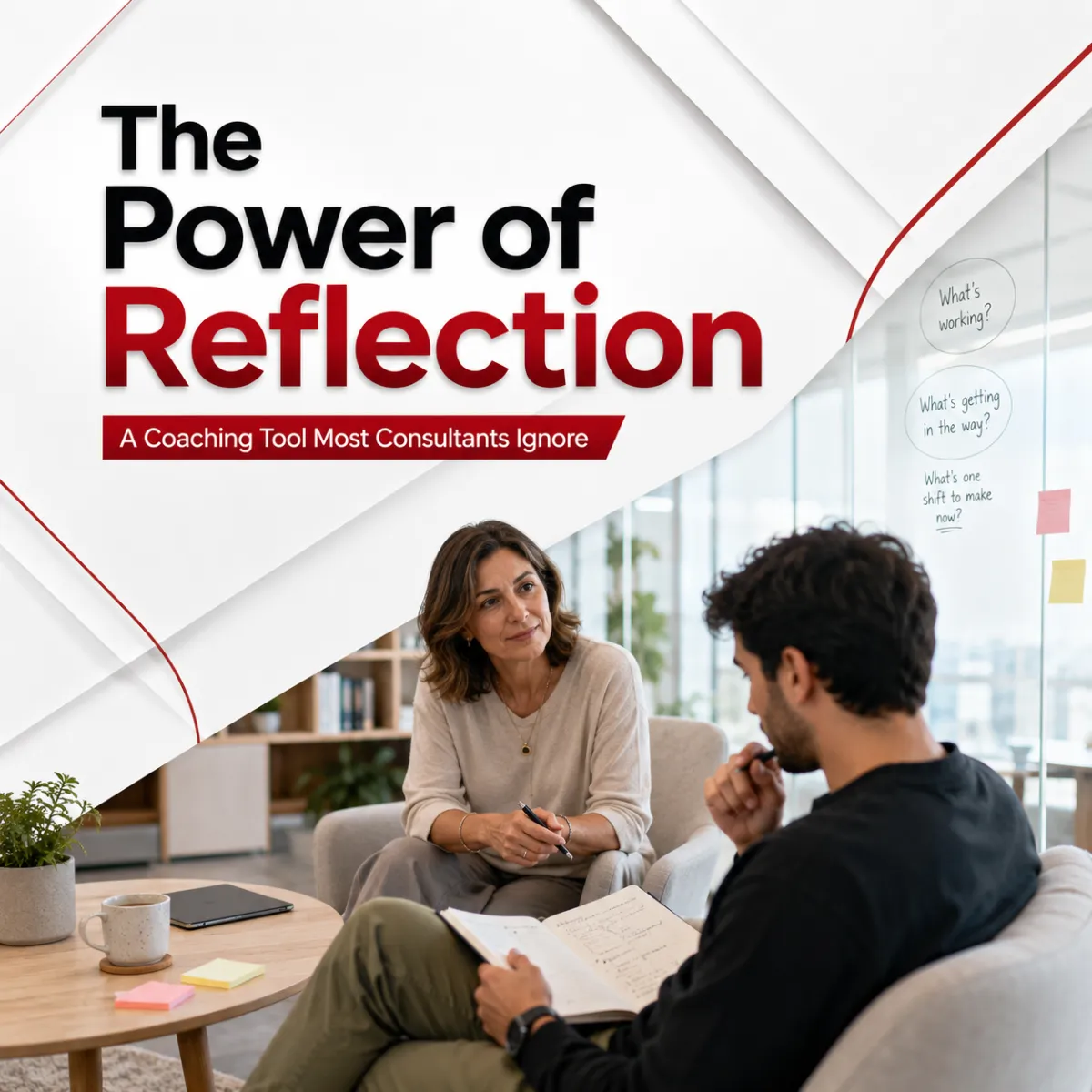
The Power of Reflection: A Coaching Tool Most Consultants Ignore
In consulting, speed is often valued. Clients want answers quickly, leaders want action immediately, and teams want solutions that can be implemented fast.
But in the rush to solve problems, many consultants overlook one of the most powerful coaching tools available: reflection.
Reflection is not passive thinking. It is a structured process that helps people learn from experience, understand patterns, and make better decisions in the future.
For consultants, reflection can turn a conversation from simple advice into real transformation.
Why Reflection Matters in Consulting
Many organizations move from one initiative to another without stopping to ask what was learned.
They complete projects, attend meetings, launch improvements, and respond to problems. But without reflection, valuable lessons are often lost.
Reflection helps clients ask:
What happened?
Why did it happen?
What did we learn?
What should we do differently next time?
These questions create deeper awareness and stronger decision-making.
At John&Partners, we believe reflection helps clients move beyond activity and toward meaningful improvement.
Reflection Turns Experience Into Learning
Experience alone does not guarantee growth.
People can repeat the same mistakes for years if they never stop to examine them.
Reflection transforms experience into insight by helping individuals and teams understand:
Their decisions
Their assumptions
Their behaviors
Their communication patterns
Their execution gaps
This insight becomes the foundation for better action.
Without reflection, experience may only create repetition.
With reflection, experience creates learning.
Why Consultants Often Ignore Reflection
Reflection is often ignored because it feels slower than giving advice.
Many consultants feel pressure to:
Provide fast answers
Demonstrate expertise
Move directly into action
Keep meetings focused on solutions
But when consultants skip reflection, they may solve surface-level problems without helping clients understand the deeper causes.
Fast advice can create short-term movement.
Reflection creates long-term capability.
Reflection Builds Client Ownership
One of the most important benefits of reflection is ownership.
When clients reflect, they do not simply receive answers from the consultant. They participate in discovering insights themselves.
This creates:
Stronger commitment
Better understanding
Greater accountability
Higher confidence
More sustainable behavior change
People are more likely to act on insights they helped uncover.
That is why reflection is a powerful coaching tool.
How Consultants Can Use Reflection Effectively
Reflection should be structured, not random.
Consultants can guide reflection by asking questions such as:
What was the intended outcome?
What actually happened?
What worked well?
What created friction?
What assumptions influenced the decision?
What lesson should we carry forward?
What action should change next time?
These questions help clients slow down just enough to think more clearly.
The purpose is not to criticize the past.
The purpose is to learn from it.
Reflection Supports Operational Excellence
Operational excellence depends on continuous improvement. Continuous improvement depends on learning.
Reflection helps organizations identify:
Process weaknesses
Communication gaps
Leadership blind spots
Execution barriers
Customer experience issues
Team alignment problems
When teams reflect regularly, they become better at recognizing patterns and improving systems.
This is how reflection supports stronger execution and better organizational performance.
Reflection Creates Better Coaching Conversations
Strong coaching is not about giving perfect answers.
It is about helping clients think better.
Reflection allows consultants to:
Ask deeper questions
Build trust
Encourage honest dialogue
Strengthen self-awareness
Support better decision-making
A reflective conversation often reveals what a direct recommendation might miss.
Sometimes the breakthrough is not in the answer.
It is in the moment the client sees the situation differently.
The Difference Between Reflection and Overthinking
Reflection should not become endless discussion.
Effective reflection is:
Focused
Time-bound
Practical
Linked to action
The goal is not to slow progress.
The goal is to improve the quality of future action.
Reflection becomes valuable when it leads to clearer decisions and better execution.
Building Reflection Into the Consulting Process
Consultants can make reflection part of the engagement by including:
End-of-meeting learning questions
After-action reviews
Project retrospectives
Leadership reflection sessions
Progress review discussions
Coaching check-ins
When reflection becomes a habit, improvement becomes more consistent.
Organizations stop repeating the same mistakes and start building stronger systems.
Final Takeaway
Reflection is one of the most underused tools in consulting.
It helps clients understand what happened, why it happened, and how to improve next time.
At John&Partners, we believe reflection is not a delay in progress. It is a discipline that improves progress.
Action drives movement.
Reflection creates learning.
Together, they create sustainable transformation.