
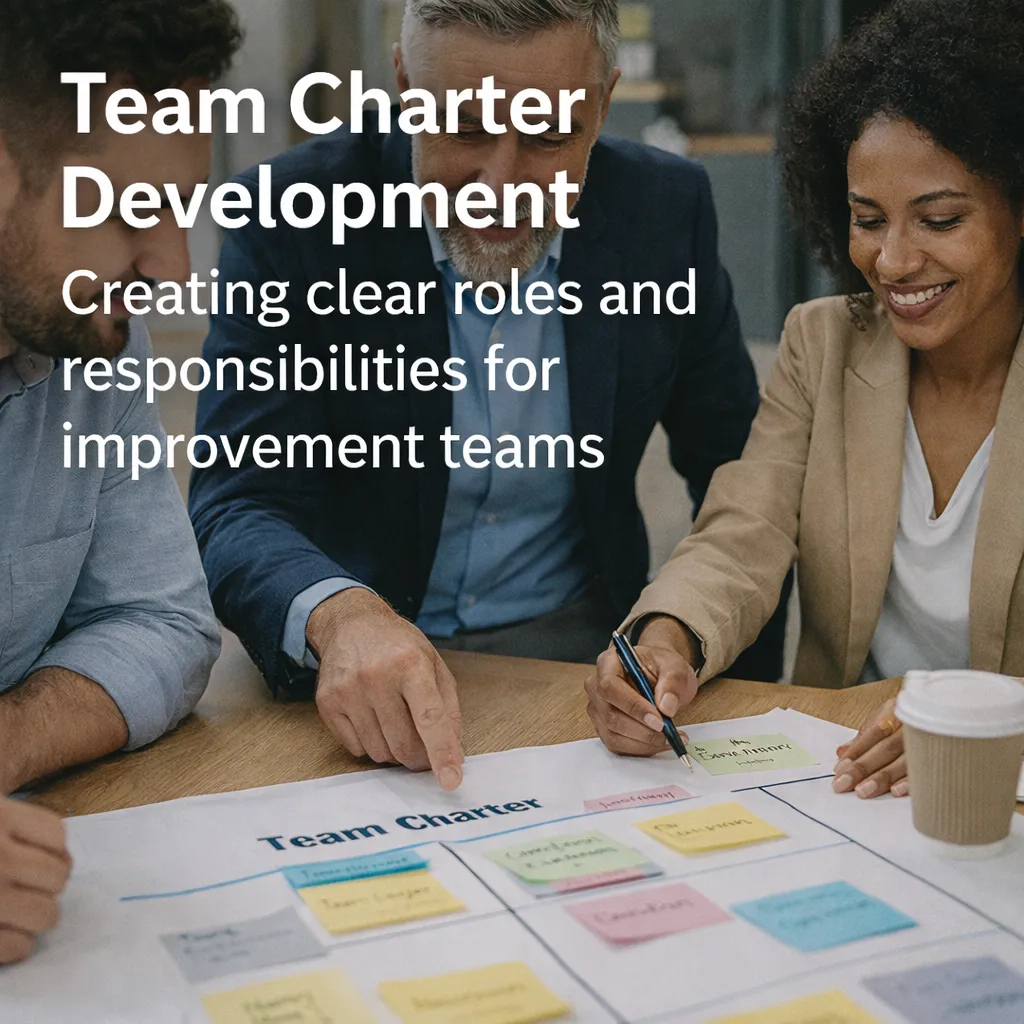
Team Charter Development: Creating clear roles and responsibilities for improvement teams
Why Improvement Teams Fail Before the First Meeting—and How to Prevent It
Many organizations launch improvement initiatives with strong intentions, talented people, and ambitious goals. Yet too often, these teams stall, argue, or quietly lose momentum.
The root cause is rarely a lack of skill or commitment. It’s a lack of clarity.
This is where Team Charter Development becomes a critical foundation for success.
What Is a Team Charter—Really?
A team charter is not just a document.
It is a shared agreement that defines why the team exists, how it works, and who is responsible for what.
A well-designed team charter answers the questions that derail most improvement efforts:
What problem are we solving?
What is in scope—and what is not?
Who makes decisions?
Who owns which responsibilities?
How will we measure success?
How will we work together?
Without these answers, teams rely on assumptions. And assumptions create friction.
Why Role Confusion Kills Improvement Efforts
When roles and responsibilities are unclear, common symptoms appear quickly:
Meetings become unproductive debates
Decisions are delayed or revisited repeatedly
Accountability is avoided or misunderstood
Team members duplicate work—or wait for others
Conflict becomes personal instead of constructive
Progress slows despite high effort
In improvement teams, confusion is costly. It wastes time, energy, and trust.
A team charter prevents these issues before they happen.
What a Strong Team Charter Includes
High-performing improvement teams use charters that clearly define:
1. Purpose and Objectives
Why the team exists and what success looks like.
2. Scope and Boundaries
What the team is responsible for—and what is outside its authority.
3. Roles and Responsibilities
Clear ownership for leadership, analysis, execution, communication, and decision-making.
4. Decision Rights
Who decides what, and how decisions are escalated when needed.
5. Ways of Working
Meeting cadence, communication norms, and collaboration expectations.
6. Metrics and Outcomes
How progress and success will be measured.
When these elements are explicit, teams move faster with less friction.
Team Charters Create Alignment—Not Control
One common misconception is that team charters limit flexibility. In reality, they enable it.
When roles are clear:
Team members act with confidence
Decisions are made closer to the work
Leaders spend less time resolving confusion
Collaboration becomes smoother
Accountability feels fair, not forced
Clarity doesn’t restrict teams—it empowers them.
The Leadership Advantage
Leaders who invest time in team charter development send a clear message:
Expectations matter
Accountability is shared
Improvement is structured, not chaotic
Time and focus are respected
This builds trust and credibility from the start of any initiative.
Why Team Charters Matter in Operational Excellence
In Operational Excellence and continuous improvement environments, teams often work across functions, hierarchies, and priorities.
A team charter acts as a neutral reference point—keeping the team aligned even when pressure increases.
It shifts conversations from: “Who is responsible?” to “What did we agree to?”
That shift alone can determine whether an improvement effort succeeds or fails.
The Real Impact
Organizations that consistently use team charters experience:
Faster execution of improvement projects
Stronger cross-functional collaboration
Reduced conflict and rework
Clearer accountability
Higher team engagement
More sustainable improvement outcomes
Because improvement doesn’t start with tools or data. It starts with alignment.
The Question Every Organization Should Ask
Before launching your next improvement initiative, ask: Have we clearly defined how this team will work—or are we hoping clarity will emerge later?
In improvement work, clarity at the beginning saves months of frustration later.
That is the true power of Team Charter Development.