


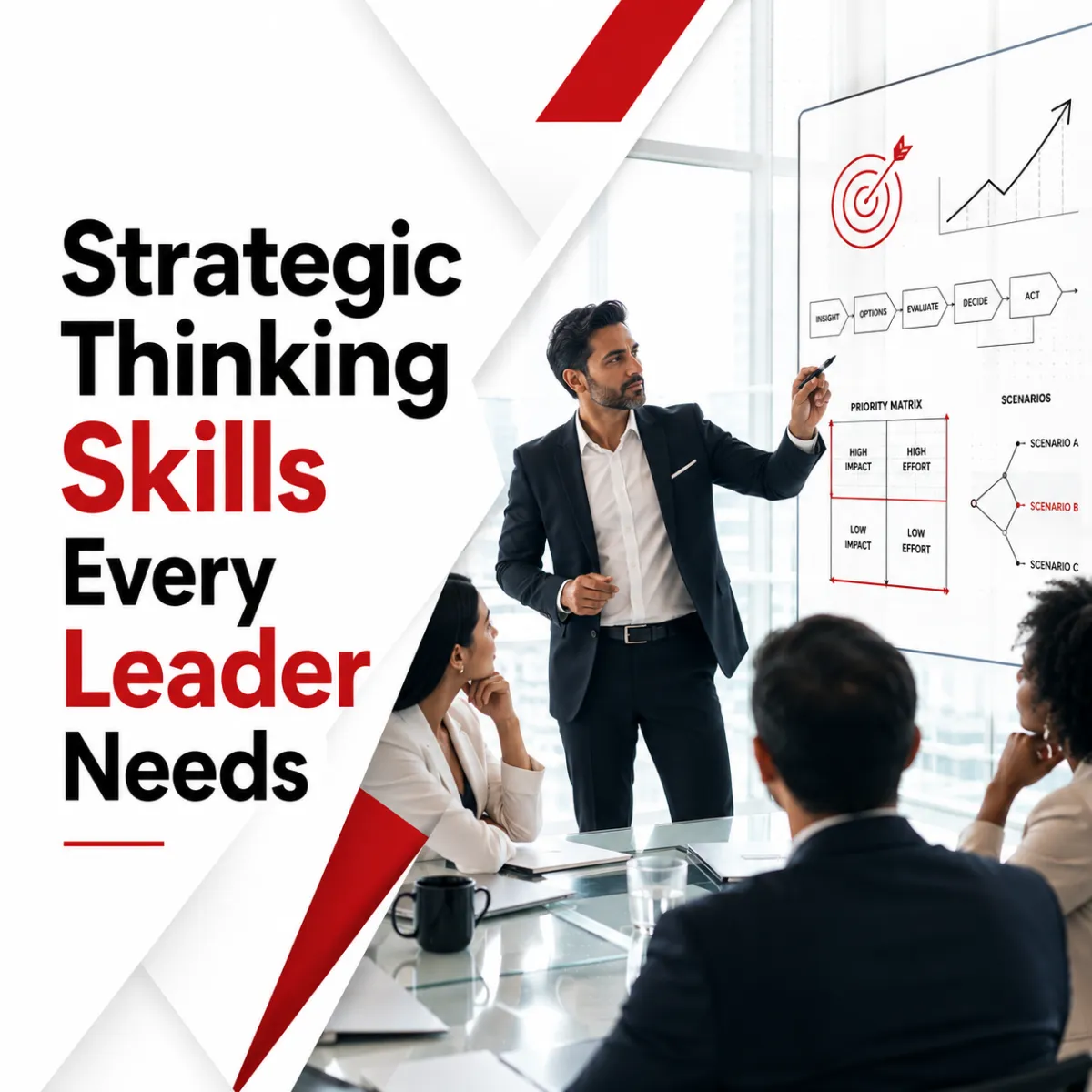
Strategic Thinking Skills Every Leader Needs
In today’s fast-changing business environment, leadership is no longer only about managing operations or solving immediate problems.
Leaders are expected to make decisions under uncertainty, anticipate market shifts, align teams, and guide organizations through continuous change.
This is why strategic thinking has become one of the most important leadership capabilities in modern business.
At John&Partners, we believe strategic thinking is not limited to executives or boardrooms. It is a practical leadership skill that helps organizations make better decisions, improve execution, and create sustainable growth.
What Is Strategic Thinking?
Strategic thinking is the ability to see beyond short-term activities and understand how decisions today influence future outcomes.
It involves:
Analyzing situations critically
Understanding long-term implications
Recognizing patterns and trends
Evaluating risks and opportunities
Aligning actions with organizational goals
Strategic thinkers do not simply react to problems. They prepare for what may come next.
This mindset helps leaders make decisions with greater clarity and direction.
Why Strategic Thinking Matters More Than Ever
Business environments are becoming more complex.
Organizations face:
Rapid technological change
Market uncertainty
Customer expectation shifts
Increased competition
Operational disruption
Economic pressure
Leaders who only focus on daily operations may struggle to adapt when conditions change.
Strategic thinking helps leaders:
Prioritize effectively
Respond proactively
Allocate resources wisely
Build organizational resilience
Improve long-term decision-making
Without strategic thinking, organizations often become reactive instead of intentional.
Strategic Thinking Is More Than Planning
Many people confuse strategic thinking with strategic planning.
Planning focuses on creating structured actions and timelines.
Strategic thinking focuses on understanding the bigger picture and making better decisions before action begins.
A strategic leader asks:
What are the long-term implications?
What assumptions are we making?
What risks may emerge?
What opportunities are changing?
How does this align with our goals?
What should we stop doing?
These questions help leaders move beyond short-term thinking.
Critical Thinking Is a Core Skill
Strong strategic leaders think critically before making decisions.
Critical thinking involves:
Evaluating information objectively
Challenging assumptions
Identifying root causes
Considering multiple perspectives
Separating facts from opinions
This skill becomes especially important during uncertainty or pressure.
Leaders who lack critical thinking may react emotionally, rush decisions, or overlook important risks.
Strategic leaders slow down enough to think clearly before acting.
Systems Thinking Helps Leaders See Connections
Organizations are systems made up of people, processes, technology, customers, and operations.
A decision in one area often affects another.
Systems thinking helps leaders understand these relationships.
For example:
A cost-cutting decision may affect customer experience
Faster production may reduce quality
Poor communication may increase operational delays
Strategic leaders recognize that business challenges are interconnected.
This helps them make more balanced and sustainable decisions.
Prioritization Is a Strategic Skill
Many organizations struggle because they try to focus on too many priorities at once.
Strategic leaders understand that not everything is equally important.
They ask:
What creates the greatest value?
What aligns with long-term goals?
What should receive attention first?
What should be delayed or eliminated?
Prioritization improves focus, execution, and resource allocation.
Without prioritization, organizations become distracted and overloaded.
Strategic Thinking Improves Decision-Making
Good decisions rarely happen by accident.
Strategic thinking improves decision quality by helping leaders:
Analyze information carefully
Consider future consequences
Understand trade-offs
Evaluate alternatives
Reduce reactive thinking
Strategic leaders understand that every decision creates ripple effects.
That awareness improves judgment and accountability.
Adaptability Is Part of Strategic Leadership
Strategic thinking does not mean creating rigid plans.
Strong leaders remain adaptable because conditions change over time.
Strategic adaptability means:
Learning continuously
Adjusting based on new information
Listening to feedback
Re-evaluating assumptions
Responding intelligently to change
Leaders who combine strategic thinking with adaptability are often more resilient during uncertainty.
Communication Strengthens Strategic Alignment
A strategy only becomes effective when people understand it.
Strategic leaders communicate:
Organizational priorities
Long-term direction
Decision rationale
Expected outcomes
Team responsibilities
Clear communication creates alignment across the organization.
Without alignment, even strong strategies may fail during execution.
How Leaders Can Develop Strategic Thinking
Strategic thinking is not an inborn talent. It can be developed through practice and reflection.
Leaders can strengthen this capability by:
Asking better questions
Studying industry trends
Reflecting on decisions
Learning from experience
Seeking diverse perspectives
Developing problem-solving skills
Practicing systems thinking
Engaging in coaching and mentoring
Strategic thinking grows when leaders intentionally improve how they analyze and respond to complex situations.
The Role of Coaching in Strategic Leadership
Coaching helps leaders improve strategic thinking by encouraging reflection, self-awareness, and deeper analysis.
Coaching conversations often help leaders:
Clarify priorities
Improve decision-making
Challenge assumptions
Explore alternative solutions
Strengthen accountability
At John&Partners, we believe coaching supports leaders not only in solving problems, but also in improving how they think.
Better thinking leads to better leadership.
Final Takeaway
Strategic thinking is one of the most important leadership skills in today’s business environment.
It helps leaders:
Make better decisions
Improve execution
Align teams
Anticipate change
Create sustainable growth
At John&Partners, we believe strong leadership is not only about managing current performance.
It is about creating direction, clarity, and long-term value in an increasingly complex world.
Because the future often belongs to leaders who can think beyond today while still executing effectively in the present.