


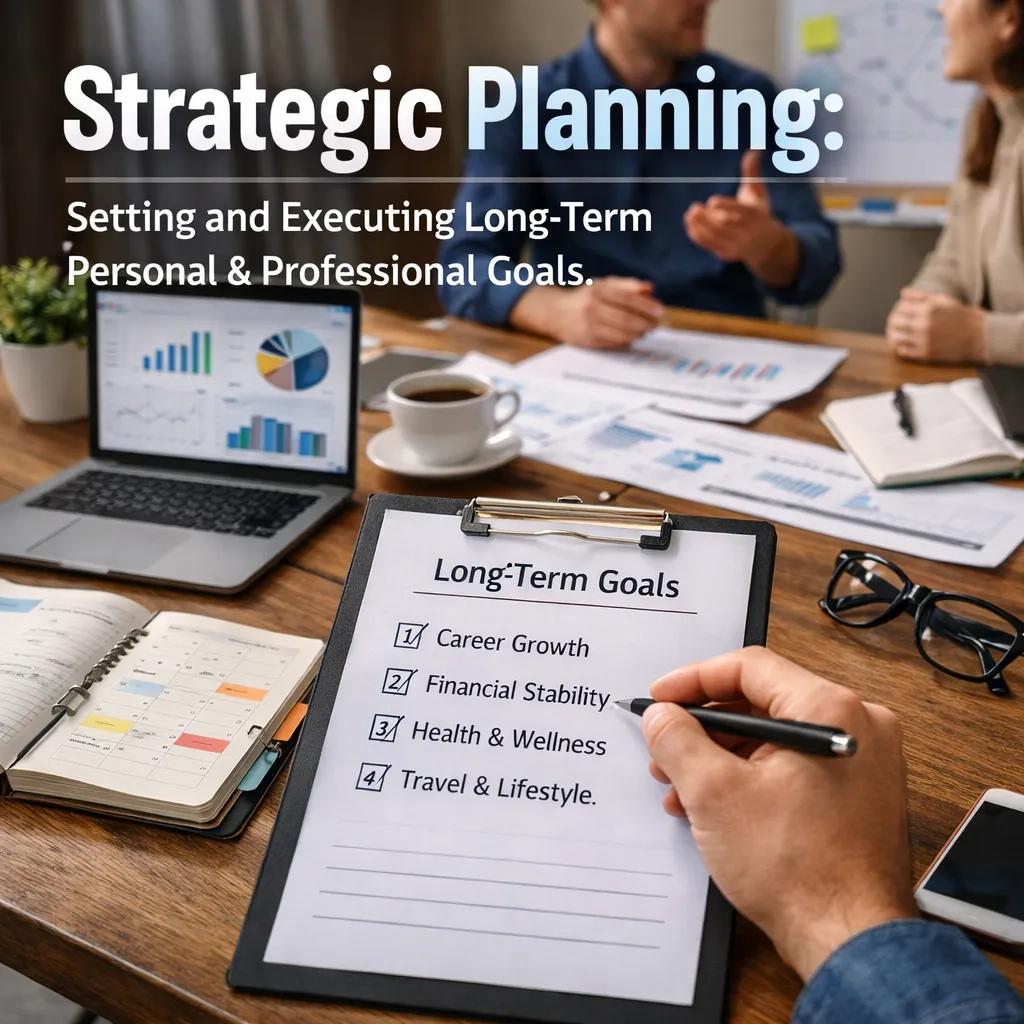
Strategic Planning: Setting and executing long-term personal and professional goals.
Why Most Long-Term Goals Fail Without a Real Strategy
Many people work hard every day, stay busy, and remain highly committed—yet still feel stuck. Careers plateau. Personal goals drift. Professional growth slows down. The issue is rarely a lack of effort.
More often, the missing piece is strategic planning.
Strategic planning is not just for organizations. It is a powerful discipline for individuals who want to set meaningful long-term goals—and actually execute them.
What Strategic Planning Really Means
Strategic planning is the structured process of:
Defining long-term direction
Clarifying priorities
Making intentional choices
Aligning daily actions with future goals
It bridges the gap between where you are today and where you want to be tomorrow, both personally and professionally.
Without strategy, goals remain aspirations. With strategy, they become executable plans.
Why Goals Alone Are Not Enough
Many people set goals but fail to achieve them because:
Goals are vague or unrealistic
Priorities conflict with daily demands
Progress is not measured consistently
Decisions are reactive instead of intentional
Execution lacks structure and accountability
Strategic planning addresses these gaps by turning ambition into direction—and direction into action.
The Foundation: Clarity of Purpose
Effective strategic planning starts with clarity. This includes:
Understanding personal values and motivations
Defining what success truly means
Identifying long-term professional aspirations
Recognizing constraints and trade-offs
When purpose is clear, decision-making becomes easier. Time and energy are spent on what truly matters.
From Vision to Strategy
Vision answers where you want to go.
Strategy answers how you will get there.
A strong personal or professional strategy:
Focuses on a small number of priorities
Aligns strengths with opportunities
Accounts for risks and limitations
Creates a realistic path forward
Strategy requires saying “no” to distractions so that “yes” has meaning.
Execution: Where Strategy Succeeds or Fails
Execution is the most overlooked part of strategic planning.
Successful execution involves:
Breaking long-term goals into milestones
Translating milestones into weekly and daily actions
Establishing routines and habits that support progress
Tracking results and adjusting when needed
Strategy without execution is just intention. Execution without strategy is wasted effort.
Strategic Planning in Professional Growth
For professionals and leaders, strategic planning helps:
Guide career development intentionally
Build capabilities aligned with future roles
Avoid burnout caused by unfocused effort
Increase credibility through consistent delivery
Prepare for leadership and transition opportunities
Those who plan strategically grow faster—not because they work more, but because they work with purpose.
Personal Strategic Planning Builds Resilience
Life and business are unpredictable. Strategic planning does not eliminate uncertainty—but it improves resilience.
When direction is clear:
Setbacks become course corrections, not failures
Decisions are grounded in long-term intent
Confidence increases during uncertainty
Adaptation becomes easier and faster
Strategic thinkers respond rather than react.
Common Mistakes in Strategic Planning
To be effective, strategic planning must avoid:
Overcomplicating the plan
Setting too many priorities
Ignoring execution discipline
Failing to review and adjust regularly
Treating strategy as a one-time exercise
Strategy is not static. It evolves as conditions change.
Strategy as a Continuous Practice
The most effective individuals treat strategic planning as an ongoing habit:
Regular reflection and review
Periodic adjustment of goals
Continuous learning and capability building
Honest evaluation of progress
This creates momentum and sustained growth over time.
The Bottom Line
Strategic planning is not about controlling the future.
It is about preparing for it intentionally.
When long-term goals are clearly defined and consistently executed, progress becomes visible, measurable, and sustainable.
Key Takeaway
Hard work creates motion.
Strategic planning creates direction.
Execution turns direction into results.