


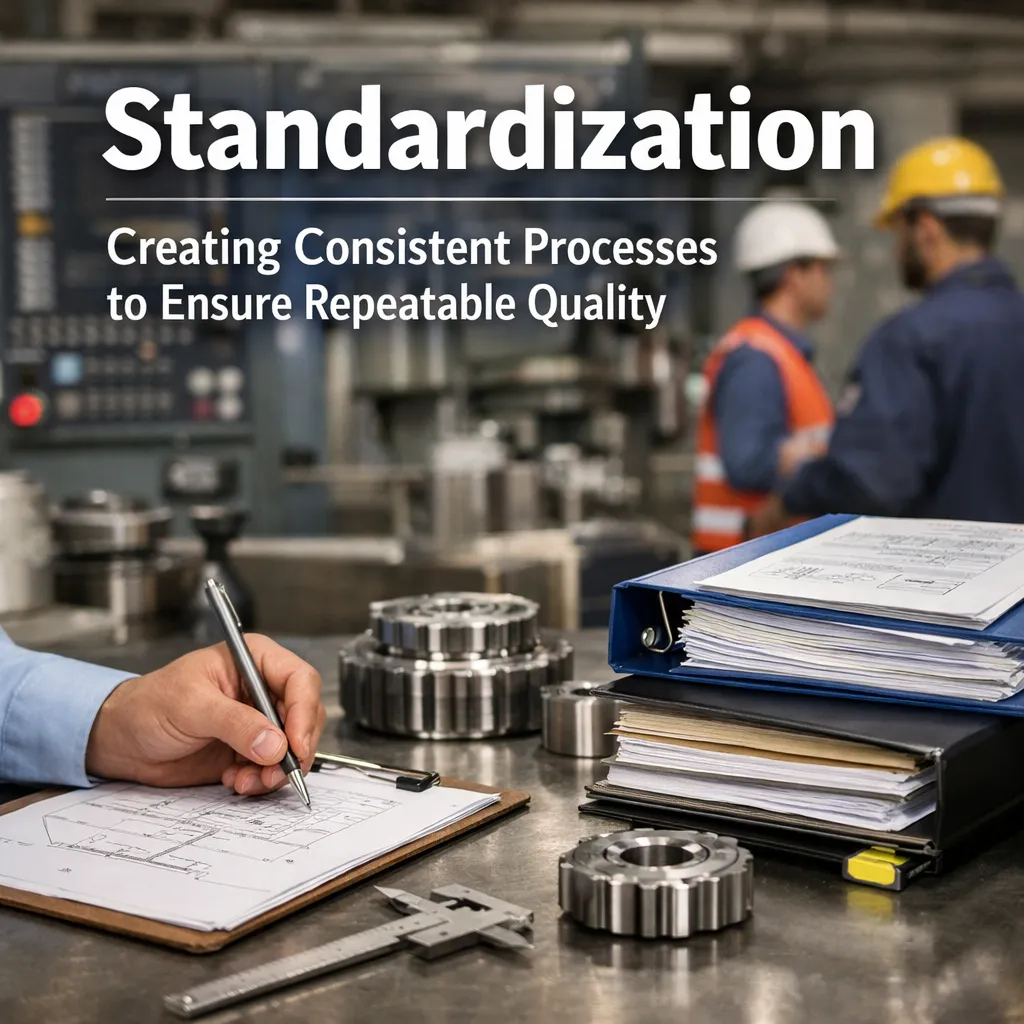
Standardization: Creating consistent processes to ensure repeatable quality.
Why Quality Breaks Down—Even When Teams Are Skilled
Many organizations struggle with inconsistent quality. One day results are excellent. The next, errors appear, customers complain, or rework increases. Leaders often blame people, training, or motivation.
But inconsistency is rarely a people problem. It’s a process problem.
This is where standardization becomes a foundation for repeatable quality and sustainable performance.
What Standardization Really Means
Standardization is often misunderstood as rigid rules or lack of flexibility. In reality, standardization means defining the best known way to perform a task—based on experience, data, and learning.
Effective standardization:
Defines clear steps and expectations
Reduces variation in how work is done
Makes quality predictable and repeatable
Creates a common language across teams
Establishes a baseline for improvement
Standardization does not stop improvement. It enables it.
Why Inconsistency Happens Without Standards
When processes are not standardized:
People rely on personal habits and assumptions
Work is performed differently across shifts or teams
Training becomes informal and unreliable
Errors are repeated but not clearly understood
Performance depends on individuals instead of systems
In these environments, quality becomes fragile—and hard to scale.
Standardization as the Foundation of Quality
Consistent quality requires consistency in execution.
Standardized processes:
Reduce defects and rework
Improve first-time-right performance
Make expectations clear for everyone
Support faster onboarding and training
Increase confidence in outcomes
When everyone follows the same proven process, results become predictable.
Standardization Makes Problems Visible
One of the most powerful benefits of standardization is transparency.
When work is standardized:
Deviations are easy to detect
Root causes can be identified faster
Improvement discussions become factual, not emotional
Teams focus on fixing processes—not blaming people
Without standards, it is impossible to know what “normal” looks like—and impossible to improve reliably.
Standardization Does Not Kill Flexibility
A common concern is that standardization limits creativity. In practice, the opposite is true.
Standardization:
Eliminates unnecessary variation
Frees teams from constant decision-making
Creates stability in daily operations
Allows flexibility where it truly adds value
Once the basics are stable, teams can innovate with confidence.
The Role of Leadership in Standardization
Standardization succeeds only when leaders support it.
Effective leaders:
Encourage teams to document best practices
Involve frontline employees in defining standards
Treat standards as living documents
Reinforce adherence through coaching, not control
Support continuous improvement of standards over time
When leaders respect standards, teams follow.
Standardization and Continuous Improvement
Standardization and improvement are not opposites—they are partners.
The cycle works like this:
Define the best known way (standard)
Follow the standard consistently
Identify gaps or opportunities
Improve the process
Update the standard
Without standards, improvement is random.
With standards, improvement is systematic.
The Business Impact of Standardization
Organizations that apply standardization effectively experience:
Consistent quality and customer satisfaction
Reduced errors and rework
Lower operating costs
Faster training and onboarding
Improved safety and compliance
Greater scalability
Stronger operational discipline
Standardization turns performance from unpredictable to dependable.
From Individual Effort to System Reliability
High-performing organizations do not rely on heroes. They rely on systems that work every day.
Standardization shifts success from individual effort to organizational capability.
The Question Leaders Should Ask
Instead of asking: Why do different teams get different results?
Ask: Have we defined and reinforced a clear standard for how work should be done?
Because repeatable quality does not happen by chance. It is built through clear standards, disciplined execution, and continuous learning. That is the true power of standardization.