

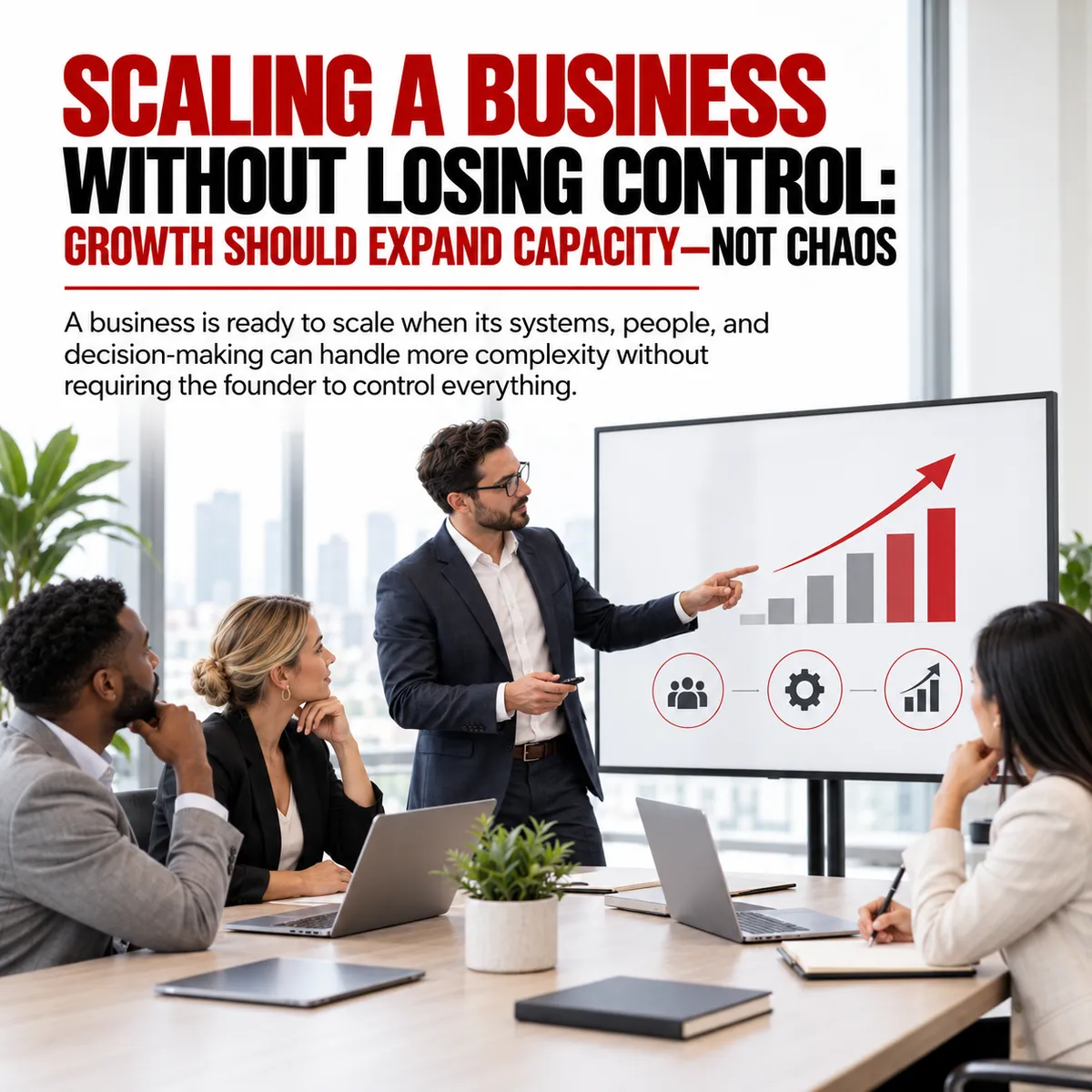
SCALING A BUSINESS WITHOUT LOSING CONTROL: GROWTH SHOULD EXPAND CAPACITY—NOT CHAOS
A business is ready to scale when its systems, people, and decision-making can handle more complexity without requiring the founder to control everything.
Growth Can Expose What a Smaller Business Could Hide
Growth is exciting.
More customers arrive. Revenue opportunities increase. New employees join. Products expand. Additional locations or markets become possible.
But growth does not automatically make a business stronger.
Sometimes it simply makes existing weaknesses bigger.
A process that works with 20 customers may struggle with 200. Informal communication that works with five employees may create confusion with 50. A founder who can personally approve every important decision in a small company may become a bottleneck as the organization expands.
That is why scaling is different from simply growing.
Growth increases activity. Scaling requires the organization to increase its capacity to manage that activity.
The Founder Cannot Remain the Operating System
In the early stages, founder involvement is often an advantage.
The founder knows the customers, approves spending, solves problems, manages relationships, checks quality, and makes key decisions.
But what helps a company survive at the beginning can eventually limit its ability to scale.
If employees constantly ask, “What does the founder want?” before acting, decision-making becomes centralized.
If every customer issue requires founder involvement, service capacity remains limited.
If important knowledge exists only in the founder’s head, the organization cannot easily reproduce successful practices.
Scaling requires a transition from:
“The founder knows how the business works”
to:
“The organization knows how the business works.”
Standardize What Should Be Repeatable
Not every activity needs a detailed procedure.
But work that is frequent, important, risky, or closely connected to customer experience should not depend entirely on individual memory.
Businesses preparing to scale should identify their critical processes.
How are leads handled?
How are customers onboarded?
How are orders fulfilled?
How is quality checked?
How are complaints resolved?
How are employees trained?
How are financial approvals managed?
Documenting and improving these processes creates a foundation for consistency.
The objective is not bureaucracy.
The objective is to make successful execution easier to repeat.
Clarify Who Owns What
As organizations grow, unclear ownership becomes expensive.
Two people may assume the other person is responsible. Several managers may make conflicting decisions. Employees may escalate routine issues because they are unsure who has authority.
A scalable organization needs more than job titles.
It needs clarity around accountability and decision rights.
Who owns the outcome?
Who makes the decision?
Who provides input?
What requires escalation?
What can employees decide independently?
When these boundaries are clear, the business can move faster without requiring senior leadership to supervise every action.
Build Leaders Before You Need Them
Hiring more employees does not automatically increase management capacity.
Someone still needs to set priorities, coordinate work, coach people, resolve conflicts, monitor performance, and make decisions.
That is why leadership development becomes increasingly important as a company scales.
Founders need managers who can take genuine ownership—not simply pass information upward.
Managers, in turn, need the judgment and authority to lead within defined boundaries.
Delegation without capability can create risk.
Capability without authority creates frustration.
Effective scaling requires both.
Measure the Business Without Watching Everything
Founders often maintain control through direct observation.
They know what is happening because they are involved everywhere.
That approach becomes less practical as the organization expands.
The alternative is not to lose visibility. It is to build better visibility.
A growing business should identify a focused set of indicators that help leaders understand areas such as sales, cash flow, customer experience, quality, productivity, delivery, capacity, and employee performance.
The exact metrics depend on the business.
The principle is more important:
Leaders should not need to personally observe every activity to understand whether the system is performing as expected.
Do Not Automate a Broken Process
Technology can support scale by reducing repetitive work, improving information flow, connecting teams, and making performance easier to monitor.
But technology does not automatically create a scalable operation.
If the underlying process is confusing, unnecessary, or poorly designed, automation may simply allow the organization to perform inefficient work faster.
Before implementing technology, ask:
What problem are we solving?
Does this activity need to exist?
Can the process be simplified first?
Where does human judgment still matter?
What information should the technology make visible?
The sequence matters.
Simplify. Standardize. Then automate where appropriate.
Protect the Customer Experience While Volume Increases
One of the clearest signs of uncontrolled growth is declining customer experience.
Response times become longer.
Errors increase.
Employees become overwhelmed.
Communication becomes inconsistent.
Quality varies depending on who performs the work.
A scalable business must understand which elements of the customer experience should remain consistent as volume increases.
This may require clearer service standards, stronger training, better capacity planning, improved quality controls, or more structured feedback systems.
Growth that consistently damages customer trust is difficult to sustain.
Watch for Complexity That Does Not Create Value
As businesses grow, complexity often grows with them.
More meetings.
More approvals.
More reports.
More management layers.
More software.
More policies.
More handoffs.
Some complexity is necessary. Larger organizations genuinely require more coordination and control.
But not every additional layer creates value.
Leaders should periodically ask whether new structures are helping the organization operate better or simply making work harder.
Scaling should create greater capability—not unnecessary bureaucracy.
Build Control Into the System
“Losing control” does not necessarily mean leaders stop approving everything.
In fact, requiring leadership approval for everything can itself become a form of organizational weakness.
A stronger model is to build appropriate controls into the operating system.
Clear policies.
Defined authority.
Performance indicators.
Financial controls.
Quality standards.
Escalation rules.
Regular operating reviews.
Documented responsibilities.
Feedback mechanisms.
These structures allow leaders to delegate while maintaining appropriate visibility and accountability.
Control becomes part of the system rather than the personal workload of one individual.
Know When the Business Is Not Ready to Scale
Not every growing company should immediately accelerate expansion.
Before scaling, leaders should examine whether the underlying model is sufficiently stable.
Is customer demand understood?
Are important processes repeatable?
Are unit economics reasonably understood?
Can quality be maintained?
Is leadership capacity developing?
Can the organization recruit and train effectively?
Are financial resources appropriate for the planned expansion?
Can critical activities operate without constant founder intervention?
Scaling an unstable model can multiply instability.
Sometimes the most strategic growth decision is to strengthen the foundation before expanding further.
Scaling Changes the Founder’s Job
Perhaps the most difficult part of scaling is not operational.
It is personal.
The founder who once created value by doing everything may need to create value differently.
Instead of solving every problem, they build people who can solve problems.
Instead of making every decision, they design decision systems.
Instead of controlling every process, they establish standards and review performance.
Instead of being at the center of daily execution, they spend more time on direction, leadership, capability, and the future of the business.
This transition can be uncomfortable.
But without it, the organization may continue growing while remaining structurally small.
Final Thought
Scaling does not mean removing control.
It means changing how control works.
The goal is not a business where the founder knows everything, approves everything, and solves everything.
The goal is an organization where the right people have the right responsibilities, repeatable work is supported by effective systems, performance is visible, and decisions can be made at the appropriate level.
At John&Partners, we view sustainable scaling as an organizational capability—not simply a growth target.
No framework can eliminate the uncertainty or risks associated with expansion. Every organization must adapt its systems to its industry, strategy, resources, and stage of development.
But one principle remains important:
A business is not truly scaling if every increase in growth requires an equal increase in founder involvement.
Build the systems.
Develop the people.
Clarify the decisions.
Strengthen visibility.
Remove unnecessary complexity.
Growth should make the organization more capable—not make the founder more overwhelmed.