

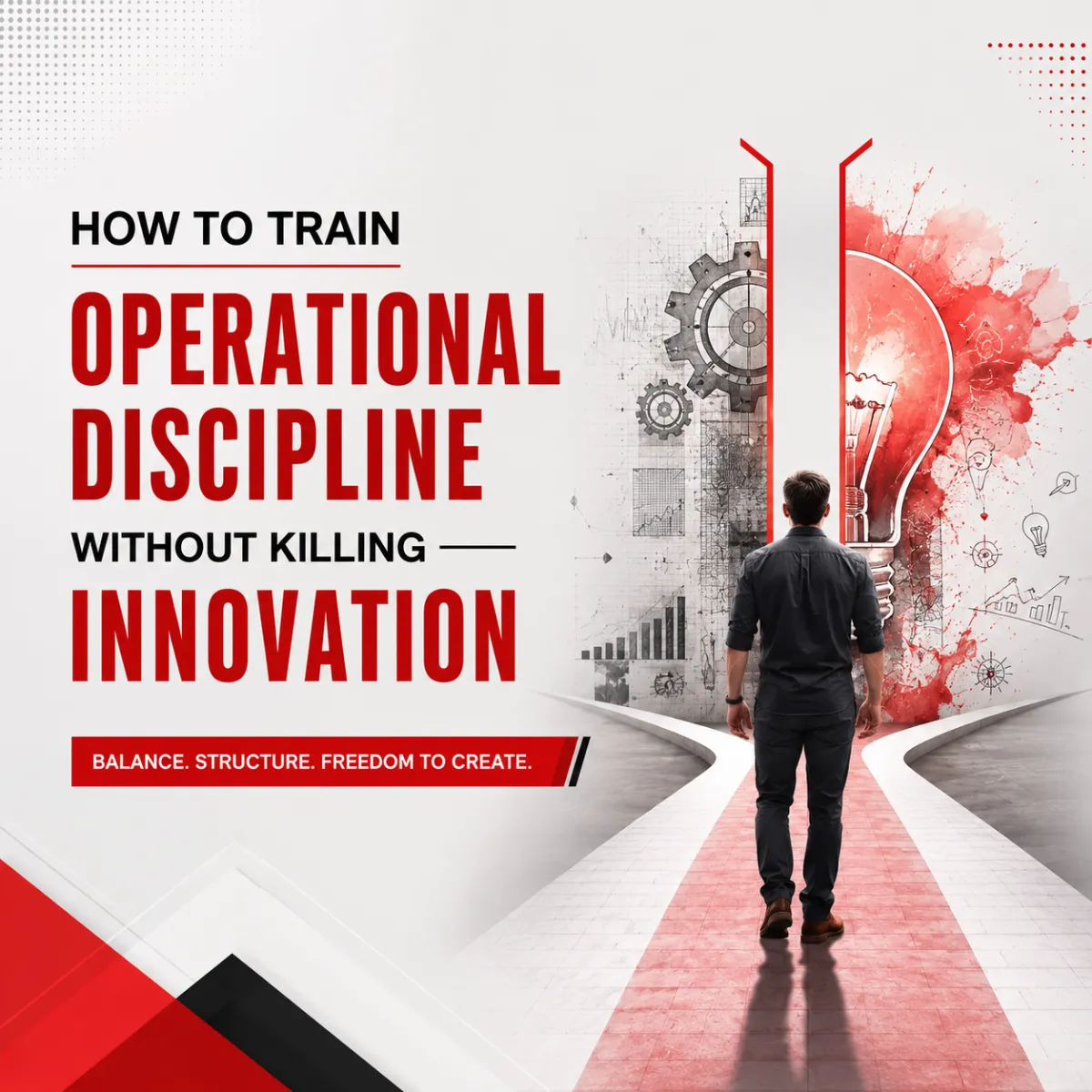
How to Train Operational Discipline Without Killing Innovation
Many organizations believe operational discipline and innovation are opposites. They assume that more structure means less creativity, more rules mean less flexibility, and more control means fewer new ideas.
But this is a misunderstanding.
The strongest organizations do not choose between discipline and innovation. They build both.
Operational discipline creates the stability that allows innovation to grow with less confusion, less waste, and better execution.
Why Operational Discipline Matters
Operational discipline means doing the right things consistently.
It helps organizations create:
Clear expectations
Repeatable processes
Strong accountability
Better communication
Reliable execution
Consistent performance
Without discipline, innovation often becomes scattered. Teams may have great ideas, but those ideas fail because priorities are unclear, ownership is weak, or execution is inconsistent.
Discipline does not block innovation. Poorly designed discipline does.
Why Innovation Needs Structure
Innovation is not only about creativity. It is also about turning ideas into useful results.
To make innovation successful, organizations need:
Clear problem definitions
Decision-making criteria
Testing methods
Feedback loops
Resource discipline
Leadership support
Without structure, innovation becomes random. With the right structure, innovation becomes repeatable.
A good system does not tell people to stop thinking. It helps people think better.
The Difference Between Control and Discipline
Many organizations confuse discipline with control.
Control says:
Follow the rule because it exists
Do not question the process
Avoid mistakes at all costs
Discipline says:
Understand the standard
Follow what works
Improve what does not
Learn from problems
Create better ways of working
Control can create fear. Discipline creates clarity.
Innovation needs clarity, not fear.
How to Train Operational Discipline the Right Way
Training operational discipline should not focus only on compliance. It should help people understand why systems matter and how good systems support better performance.
Effective training should include:
Clear standards for daily work
Practical examples from real operations
Problem-solving methods
Root cause thinking
Accountability routines
Continuous improvement habits
The goal is to help people see discipline as a tool for better execution, not as a restriction.
Give Teams Freedom Within a Framework
Innovation works best when teams know the boundaries.
Leaders should define:
What outcomes matter
What standards must be protected
What risks are acceptable
Where experimentation is encouraged
How learning will be captured
This gives teams room to explore without creating unnecessary chaos.
Freedom without alignment creates confusion.
Alignment without freedom creates stagnation.
The right framework creates both focus and creativity.
Build Psychological Safety
People will not innovate if they fear punishment for every mistake.
Operational discipline should separate careless execution from responsible experimentation.
Teams should be encouraged to:
Raise problems early
Suggest improvements
Test ideas safely
Share lessons learned
Challenge outdated processes respectfully
When people feel safe to learn, they become more willing to improve.
Use Standards as a Starting Point, Not the Final Answer
Standards are important because they define the best known way of working today.
But standards should not be frozen forever.
A strong organization uses standards to:
Create consistency
Identify gaps
Make problems visible
Support training
Improve performance
Then, when a better method is found, the standard should be updated.
This is how discipline and innovation work together.
Leadership Sets the Tone
Leaders play a critical role in balancing discipline and innovation.
They must:
Reinforce standards clearly
Encourage improvement ideas
Avoid micromanagement
Reward learning and ownership
Ask better questions
Support disciplined experimentation
If leaders only demand compliance, innovation slows down.
If leaders ignore discipline, execution weakens.
Strong leaders build both.
The Business Impact
When operational discipline and innovation work together, organizations gain:
More consistent execution
Faster problem-solving
Better customer experience
Lower operational waste
Stronger teamwork
More scalable innovation
Sustainable performance improvement
Innovation becomes more than a creative moment. It becomes part of how the organization improves every day.
Final Takeaway
Operational discipline should not kill innovation.
It should protect the organization from chaos and create the conditions for better ideas to become real results.
At John&Partners, we believe discipline creates stability, stability creates focus, and focus creates stronger innovation.
The goal is not to control creativity.
The goal is to build systems that help creativity become measurable business impact.