

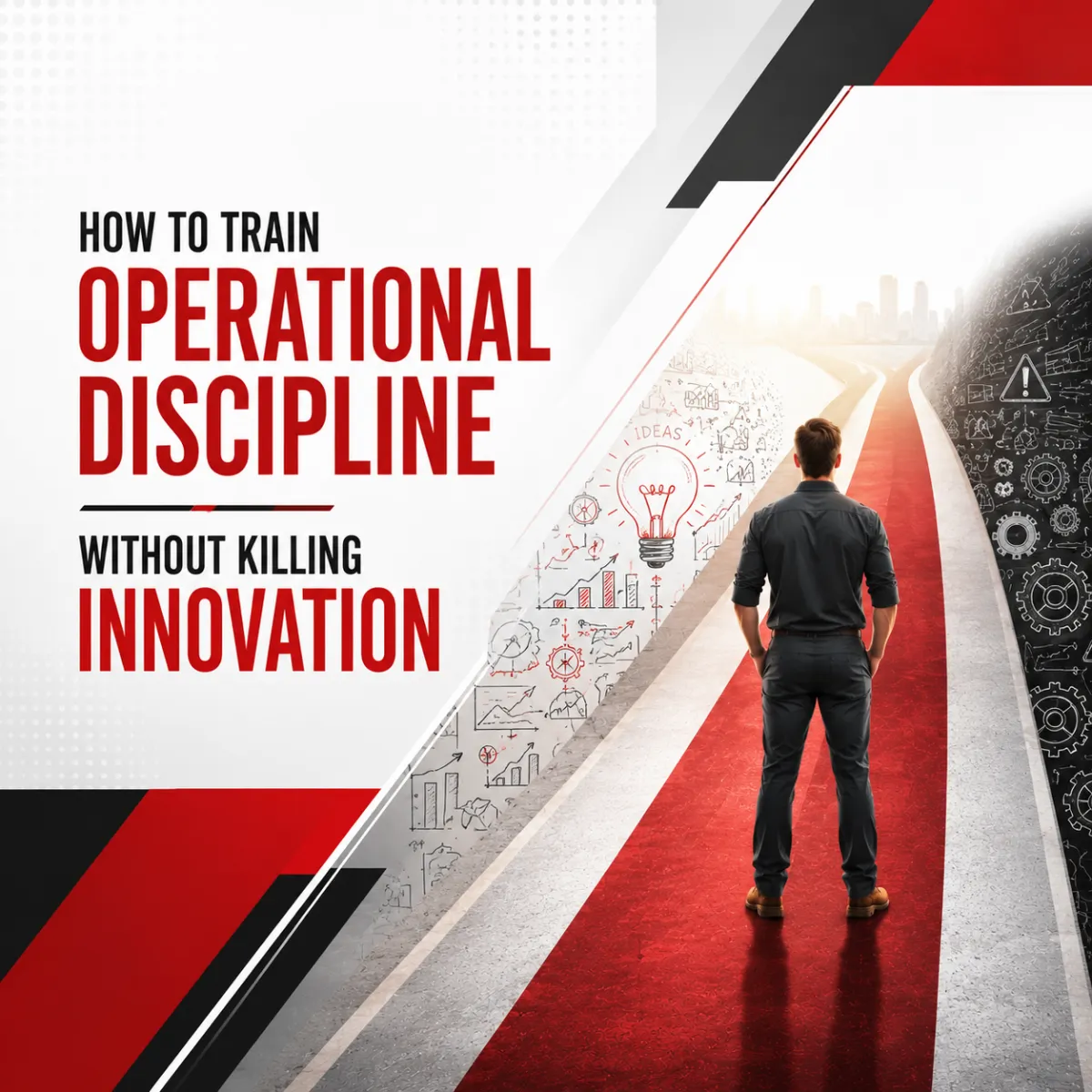
How to Train Operational Discipline Without Killing Innovation
Why the Strongest Organizations Balance Structure and Creativity Instead of Choosing One Over the Other
One of the biggest misconceptions in business is the belief that operational discipline limits innovation.
Many leaders worry that:
Too many processes reduce creativity
Standardization slows adaptability
Accountability systems discourage experimentation
Structure makes organizations rigid
But the reality is very different.
The world’s most innovative organizations are often highly disciplined operationally. They understand that innovation without structure creates chaos, while structure without innovation creates stagnation.
At John&Partners, we believe sustainable growth happens when organizations build operational discipline that supports innovation—not suppresses it.
Because the goal is not to control creativity.
The goal is to create an environment where innovation can scale consistently and effectively.
Why Operational Discipline Matters
Operational discipline creates organizational stability.
It helps businesses:
✔ Improve consistency
✔ Reduce unnecessary errors
✔ Strengthen execution quality
✔ Improve accountability
✔ Scale operations more effectively
✔ Create predictable performance
Without operational discipline:
Teams become reactive
Priorities shift constantly
Communication breaks down
Execution becomes inconsistent
Innovation becomes difficult because organizations spend too much time managing operational chaos.
- Strong systems reduce operational friction.
- Reduced friction creates more capacity for innovation.
Why Innovation Often Fails in Organizations
Many organizations encourage innovation verbally—but unintentionally create environments where innovation struggles.
Common barriers include:
Fear of failure
Excessive bureaucracy
Unclear decision-making
Lack of psychological safety
Inconsistent leadership support
Reactive operational culture
In these environments, employees may avoid experimentation because the system punishes mistakes more than it rewards learning.
Innovation requires more than creative ideas.
It requires:
✔ Trust
✔ Clarity
✔ Structured experimentation
✔ Leadership support
✔ Operational alignment
Discipline and Innovation Are Not Opposites
One of the most important leadership lessons is understanding that discipline and innovation can strengthen each other.
Operational discipline helps organizations:
Prioritize ideas more effectively
Test improvements systematically
Scale successful innovations consistently
Reduce execution risk
Improve learning speed
Innovation becomes more sustainable when supported by:
✔ Clear processes
✔ Defined goals
✔ Structured feedback loops
✔ Data-driven evaluation
✔ Accountability systems
Without structure, innovation often remains inconsistent and difficult to scale.
The Difference Between Rigidity and Discipline
Some organizations confuse discipline with control.
But true operational discipline is not about:
Micromanagement
Excessive rules
Restricting creativity
Eliminating flexibility
Strong operational discipline creates:
Alignment
Clarity
Consistency
Decision-making support
Space for focused innovation
Rigidity blocks adaptation.
Discipline supports scalable execution.
How Strong Organizations Train Operational Discipline
Organizations that balance discipline and innovation often focus on several key areas:
✔ Clear Operating Standards
Teams need consistency in core processes while still having flexibility for improvement and experimentation.
✔ Structured Problem-Solving
Employees are encouraged to identify inefficiencies, analyze root causes, and suggest improvements systematically.
✔ Accountability With Autonomy
People understand expectations clearly while still having ownership over execution and innovation.
✔ Continuous Improvement Culture
Innovation becomes part of everyday operations instead of isolated brainstorming sessions.
✔ Leadership Alignment
Leaders reinforce both operational consistency and improvement thinking simultaneously.
Psychological Safety Drives Better Innovation
Innovation grows faster when employees feel safe to:
Ask questions
Challenge assumptions
Share ideas
Experiment responsibly
Learn from mistakes
When organizations punish every failure, employees stop innovating.
At John&Partners, we believe leadership should distinguish between:
✔ Responsible experimentation
✔ Careless execution
Because learning-driven innovation strengthens organizations over time.
Why Standardization Can Actually Accelerate Innovation
Many high-performing organizations standardize routine work intentionally.
Why?
Because when repetitive tasks become more efficient:
Teams save time
Operational confusion decreases
Decision fatigue reduces
Resources become available for innovation
Standardization creates operational stability that allows teams to focus on higher-value improvement opportunities.
- Strong foundations support faster innovation.
Technology Is Changing the Balance
Modern organizations increasingly use:
Automation
AI-driven analytics
Workflow systems
Real-time operational dashboards
Digital collaboration platforms
These technologies improve:
✔ Visibility
✔ Efficiency
✔ Decision-making speed
✔ Operational coordination
This allows employees to spend less time on repetitive operational issues and more time on strategic and creative work.
Common Mistakes Organizations Make
Organizations often weaken innovation when they:
Overcontrol decision-making
Ignore employee ideas
Focus only on short-term efficiency
Treat mistakes as failures instead of learning opportunities
Create unclear priorities
Lack structured innovation processes
At the same time, organizations weaken discipline when they:
Avoid accountability
Allow inconsistent execution
Overprioritize creativity without operational control
Balance is critical.
Leadership’s Role in Balancing Discipline and Innovation
Leaders play a major role in shaping organizational culture.
Strong leaders:
✔ Create clear expectations
✔ Encourage improvement thinking
✔ Support responsible experimentation
✔ Reinforce accountability
✔ Build alignment between creativity and execution
Leadership determines whether operational discipline becomes empowering—or restrictive.
Final Takeaway
Operational discipline and innovation are not competing priorities.
The strongest organizations understand:
- Discipline creates consistency.
- Consistency creates stability.
- Stability creates space for innovation.
At John&Partners, we believe sustainable growth happens when organizations build systems strong enough to support creativity—not suppress it.
Because innovation becomes truly valuable only when it can be executed, scaled, and sustained effectively.