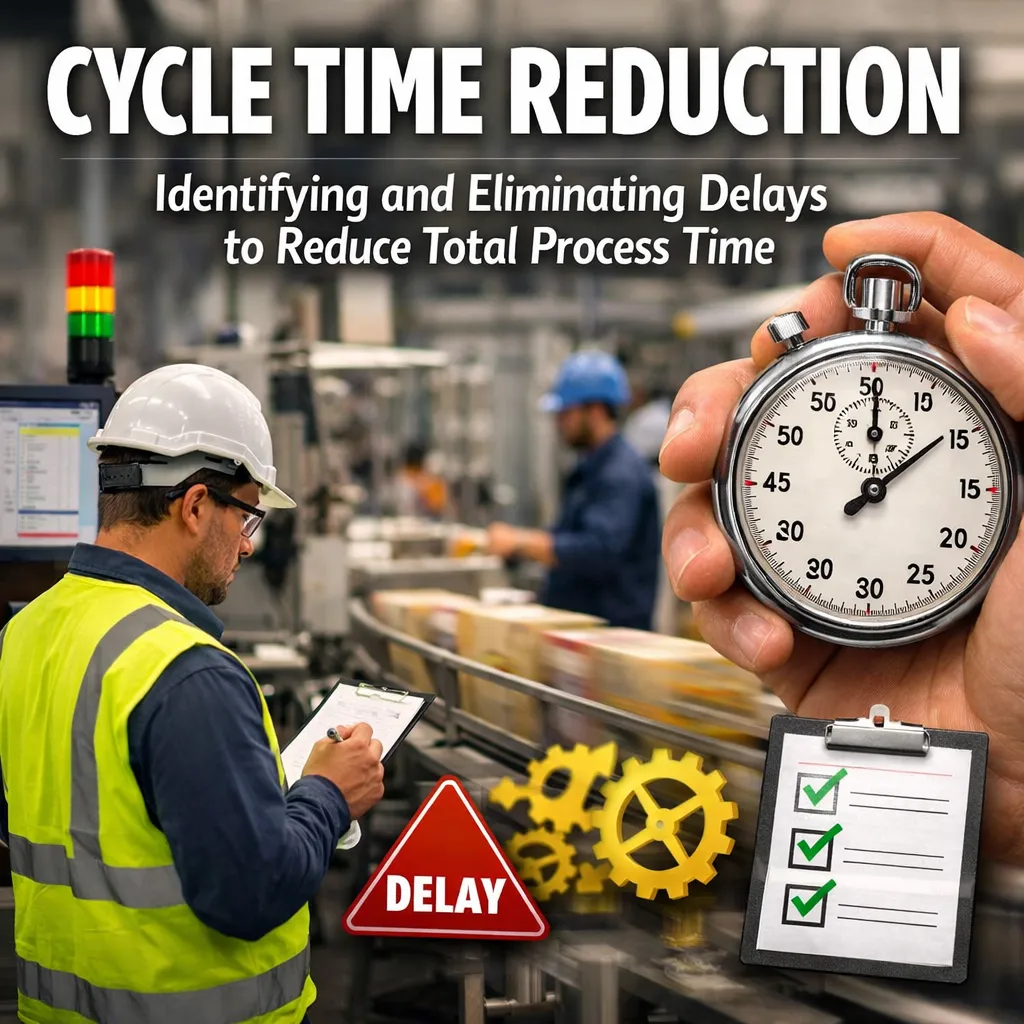
Cycle Time Reduction: Identifying and eliminating delays to reduce total process time
Why Speed Matters More Than Ever—and Where Time Is Quietly Being Lost
Many organizations feel pressure to move faster. Customers expect shorter lead times, leaders demand quicker results, and teams are pushed to work harder. Yet despite the effort, processes still feel slow.
The issue is rarely people. It’s delays hidden inside the process.
This is where Cycle Time Reduction becomes a critical driver of performance.
What Is Cycle Time—And Why It Matters
Cycle time is the total time it takes to complete a process from start to finish. It includes not only active work, but also waiting, handoffs, approvals, rework, and idle time.
When cycle time is long:
Customers wait longer
Costs increase
Errors multiply
Teams feel constant pressure
Opportunities are missed
Reducing cycle time means delivering value faster—without increasing workload.
Where Delays Typically Hide
Most delays are not obvious. They quietly accumulate across daily operations, such as:
Waiting for approvals or decisions
Excessive handoffs between teams
Rework caused by unclear requirements
Bottlenecks at overloaded steps
Manual tasks that could be automated
Poor coordination between functions
Work sitting idle in queues
Individually, these delays seem minor. Together, they stretch cycle time significantly.
Why Faster Work Isn’t the Same as Better Flow
Many organizations try to reduce cycle time by pushing people to work faster. This often leads to burnout, errors, and quality issues—without real improvement.
Effective cycle time reduction focuses on flow, not speed.
It asks:
Why is work waiting here?
What prevents this step from moving forward?
Where does work get stuck most often?
Which activities add value—and which don’t?
The goal is to remove obstacles, not increase pressure.
How Cycle Time Reduction Works in Practice
High-performing organizations reduce cycle time by:
Mapping the end-to-end process
Making waiting and queues visible
Identifying bottlenecks and constraints
Eliminating non-value-added steps
Simplifying approvals and decision paths
Reducing handoffs and rework
Aligning teams around shared flow goals
Small structural changes often deliver large time savings.
The Role of Leadership in Cycle Time Reduction
Leaders play a critical role in enabling faster flow. Effective leaders:
Encourage teams to surface delays openly
Focus on fixing systems, not blaming people
Support cross-functional collaboration
Make decisions faster and clearer
Prioritize flow over local optimization
When leaders remove barriers, cycle time improves naturally.
The Business Impact of Reducing Cycle Time
Organizations that successfully reduce cycle time achieve:
Faster delivery to customers
Lower operating costs
Improved quality and fewer errors
Better use of resources
Higher employee engagement
Greater flexibility during change
Stronger competitive advantage
Speed becomes a capability—not a constant struggle.
From Delays to Flow
Cycle Time Reduction is not about rushing work. It’s about removing what slows work down.
When delays are eliminated, processes flow smoothly, teams regain control, and performance improves without extra effort.
The Question Every Organization Should Ask
Before demanding faster results, ask: Do we clearly see where time is being lost—or are delays hidden in our processes?
Because you can’t reduce cycle time by pushing harder. You reduce it by designing better flow.
That is the true power of Cycle Time Reduction.
